|
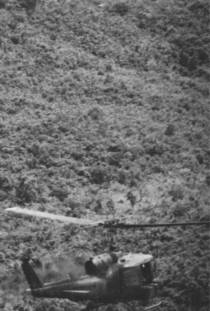
ABOVE: Flight of "Huey" helicopters fires 2.75-inch rockets at communist
positions near South Vietnam's border with Laos.
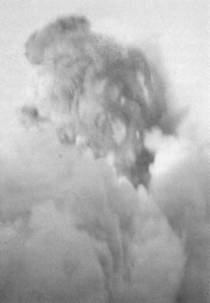
BELOW: Secondary explosions from communist ammo dump triggered by a B-52
"Arc-Light" mission. Photos: Edward Rasen
"And the next thing you knew there was normal military activity taking
place. The first sergeant got out in front and started yelling, kicking
ass and taking names.
"By this time, my team leader was about to wet his pants; this is a
storybook situation, and with this particular operation everything right
that could happen happened. He got back to the TOC
[Tactical Operations
Center] radio relay. We put
in an air
|
request right away.
It just so happened there was a flight of 105s coming back from up north
on a Rolling Thunder mission. They'd hit bad weather up there at first
light, so they couldn't expend. They were coming back hot. They had full
loads on.
"We put a request in. They were turned over to us immediately. It was
really too quick even to get a FAC [Forward Air Controller] out there. In
the meantime, this battalion started taking their jackets off and lining
up in a PT formation; dress right, cover down, you know.
"And then, by god, they started doing exercises, regular military
exercises. Well, what happened is that the team leader was given
instructions to let his smoke go, and make it. And as I say, everything
happened timing on it couldn't have been better planned if a genius had
done it. They threw the smoke, did a 180 and started making it back. And
about the time the smoke popped, here came the jets in on short final, the
smoke coming up through the trees.
"The team's last report said there was some scurrying around over there;
jets came in at treetop level and salvo-dropped everything they had. The
entire PT formation was engulfed in napalm and 500 pounders. They would
not go back over to do a bomb-damage assessment. We sent the Nung
platoon."
"That was your bomb-assessment platoon?"
"Yeah, that was the BDA team, because I always felt that if I had a Nung
platoon out there, they would do what they were told by their American
leaders if they were separated on the ground and gave any intelligence
at all back to the adviser, we could believe what they said.
"And, of course, we commanded the Nungs. We did not command the ARVN. We
were advisers to them. But the Nungs we paid 'em, we fed 'em, we
commanded 'em. They were just like another troop. So we sent the BDA
platoon back in later that afternoon, after we got the team out. That team
was on the ground probably 14 or 15 hours at the most. In the morning,
they were probably on the ground and working for an hour.
"We have no way of knowing how many we cooked, but the indications were
that hundreds were killed. It's a fluke, I guess that things fell
together and that there happened to be a flight of Tac Air available right
at the moment we asked for it, and that the request was approved
immediately. The flight came in right as the smoke popped, and they were
right on target.
"When we sent the Nungs back in, we found burnt weapons and
uniforms. We
didn't find many bodies a lot of them had been taken.
We didn't think it was
|
wise to go searching the whole valley for them. But we
did find indications of a lot of deaths: arms hanging in trees and that
kind of stuff.
"That was one of our main missions: to find something and bring smoke in
on 'em, because we always operated out of artillery range, except when the
Cav had their eight-inchers out there."
Changes And Corrections
I poured myself another cup and said, "That was the perfect recon, but it
wasn't always like that. I remember that when the Project started, the
Americans didn't even go out. Let's see. The Project existed for about six
years, from '65 to what 70, 71?"
"Yeah," Allen replied, "for a long time it was just a base for training
Vietnamese in certain operations. It wasn't an operational unit. It was
the old stigma of having the Vietnamese in command, not being able to fly
the American flag in the compound, being the adviser and all that stuff.
"The sophistication I talked about before, that we built into it, came
from the fact that I required the 281st to be in direct support and
actually attached to us. We almost made them part of the Project, you
know. They wore tiger suits and they wore the Delta triangles. We required
that the Air Force guys move down there and be part of the unit: get to
know the guys and live with us, right in the compound. We had Marines in
there too, the strategic communications group that ran the scramblers and
stuff between us and III MAF were attached to us and lived with us. Some
of those Marines were with Project Delta for nine months. We required that
they be part of the unit. They trained with the unit; everybody did. It
was one unit, not just a conglomeration of attached units.
"And, as such, we actually commanded the unit before, all operations had
to be commanded and okayed by the Vietnamese counterpart, which would plan
an operation to get the least contact. When we were holding the hammer
there, we controlled everything that ran the operation: money for the
compound, gas for the trucks ('Use my jeep, Thieu Ta, if you want to go
out tonight'), ammunition, air strikes, air support. We had a hammer so we
could say if we want to fly the American flag we will fly it. We plan an
operation, and if you want to come along you can.
"In fact, during my tenure there we did run one or two operations where we
left the Vietnamese in the compound. We caught all kinds of hell about it
though.
|