|
Behind them the chopper sped away. The team lay
listening under the brush and palms, fingers digging into wet leaves and
dirt while the dampness slowly permeated their fatigues.
When Betterton gave the signal to rise, they slowly crouched and stepped
off single file into the jungle, walking with their toes touching the
ground first.
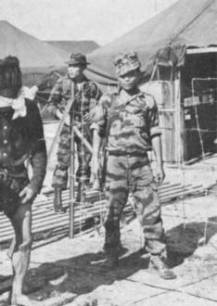
They made no more noise than wind sighing in the treetops. Tiger suits
and camouflage greasepaint blended them into the surroundings. If one of
them sat perfectly still in full view beside the trail, a man might walk
by in broad daylight and never notice him.
They moved forward about 50 meters, stopped, listened, and moved on
again. Using the last dregs of daylight, the team scanned for a thicket.
Spotting a likely place, they glided back on their trail and sank to the
earth in firing positions. No one came, so they crept into the thicket and
slid out of their packs.
Turning on the radio, Betterton whispered, "Voyager, this is Lobo, over.
"
In the handset a voice crackled back, "This is Voyager, go. "
Doc gave their positions in the same hoarse whisper and reported no
contacts or
sightings, while Hai did the same in Vietnamese. Then they
wrapped up in their plastic groundsheets and fell asleep, each man
touching at least one other. They still wore their pistol belts and
harnesses. If they had to run they could manage without their packs, but
not without the water, ammo and other gear on the harnesses.
With a rock gouging his shoulderblade and his hips digging into the
ground, Doc slept fitfully. At 0330, the growl of heavy equipment and
trucks snatched him from sleep. The enemy was building a road! Doc
scribbled in his notebook. |
At 0430, the patrol was up and creeping through the
underbrush. Avoiding ridge-lines and streambeds, they moved through the
jungle on the slopes. Frequently they heard padding footsteps on the
trails above, or the tonal undulations of Vietnamese conversation in the
creeks below. There was no attempt at concealment on the enemy's part; he
owned the territory and felt no need to hide from anything but air. Again
Doc scribbled, and spoke into the handset.
In the TOC (Tactical Operations Center) bunker, Maj. Allen and Capt. Bill
Larabee sat side by side at a big desk, plotting reports from all the
recon teams in the field. At a similar desk 10 feet away, Maj. Huan and
Capt. Ton That Luan did the same.
Across from them, Capt. Richard Dundee issued intelligence reports and
summaries to major U.S. commands, while Lt. Truong Hoang Phi cranked out
the same information to the Vietnamese Special Forces High Command.
No one on the patrol spoke a word except into the handset; they had
worked so long together that no words were necessary. On the third day,
Hai gestured toward the trail above and made a grabbing motion with his
hands. Doc, knowing he meant to try to capture a prisoner, nodded and they
crept toward the path to wait.
When someone finally came it was three North Vietnamese army regulars,
all armed with AK-47 assault rifles. The recon team opened fire from five
meters and dashed over the ridge and down the other side. When Anthony
almost walked headlong into another NVA soldier the next day and barely
beat him to the trigger, they decided it was time to pull out. Betterton
and Hai looked for LZs on their maps.
Allen saw it first. From his command-and-control ship, flying high over
the operational area, he picked out the bright blue-white flash of a
signaling mirror and spoke into his radio. Gunships, easy to spot by their
red tail markings, assumed a clockwise orbit over
the LZ, firing either at
|
at targets of opportunity or just keeping Charlie's head
down. The air was filled with the whoooosh-CRACK of rockets and the gruff
belch of mini-guns.
Flying above,
hearing the
conversation between his ship, the gunships, the TOC and the recon team on
the ground, Allen could see it all like some monstrous game laid out by
Parker Bros. At his command, the first recovery ship hopped over a
ridgeline and jockeyed down into the hole.
Doc Betterton put the mirror back into his ammo pouch. The others fanned
out in firing positions around him. The incoming recovery ship hovered a
hundred feet over them in the trees. Although Doc couldn't see Doney in
the ship, he knew who it was.
Three sandbags dragged the heavy, six-foot looped straps of the McGuire
rig down through the trees. Doc waved Ortiz and the two Vietnamese
sergeants in, and they grabbed the straps which were whipping in the wake
of rotor. Each of them sat in one loop and hooked his right wrist in a
strap that slid down tight to prevent falling, even if wounded, on the way
out.
The chopper struggled to go straight up without dragging the men through
the trees. This was the period of maximum danger maximum exposure of the
helicopter and maximum exposure for the men. They cleared the trees and
were gone.
The next ship edged into position and the straps came down again. Doc,
the heaviest of the three, jumped into the middle seat as the others
settled next to him. The chopper eased upward and they rose through the
trees, branches slapping at their faces and hands.
Then they were clear of the treetops and the ropes streamed to the rear
as the chopper surged forward, heading for a safe spot to land and take
the men inside. No matter how many times he did it, Doc never got
completely used to whipping through the air at a thousand feet, at the end
of a rope.
|