|
idea. I wasn't in as good shape as his recon people were
and I wasn't trained for that kind of work, at least not to Delta's
specifications. I had run recons before, of course, but their recon
projects had their own tricks of the trade and, although I knew about most
of them, that knowledge was not the same as experience.
But they had brought a couple of companies of the Nha Trang Mike Force
with them, and they put these guys in for five days. I went with them.
Delta's choppers had knocked out a bunch of Russian trucks running through
the A Shau Valley and Allen wanted pictures of them. His intelligence
officer, Capt. Richard Dundee, and I went in with one of the Mike Force
companies. We made a couple of contacts, got shot up fairly well, got a
few pictures of the trucks, got chased, set fire to a bunch of NVA ammo
caches and finally lost our pursuers when they got in a fire fight with
their own exploding ammunition. Dundee's shots didn't develop and Delta
commandeered the ones I'd gotten for my magazine.
Out On An Extraction
Then we walked down two kilometers of road from the trucks to our LZ. We
looked like a company coming from a training exercise, walking in a column
of twos right down that road, and I could hear NVA talking to each other
in the trees on either side of the road. They didn't bother us though. I
guess they thought we were NVA, too.
Two weeks before, the 91st Rangers had been in there. An NVA trooper had
stepped out of the woods and inquired, in Vietnamese, "What outfit are you
guys with?"
"You'll have to ask the lieutenant," was the reply, and the ARVN trooper
pointed to his CO.
"What outfit are you with?" he asked the lieutenant.
"91st Airborne Ranger Battalion," replied the lieutenant to the NVA, whose
eyes widened as he realized his mistake. The lieutenant stitched him up
the middle with an Ml6. A neat gesture, but counterproductive when you
consider their primary mission was to capture a prisoner.
The next day Allen was going out on a team extraction and I asked to go
along. He said sure.
It was interesting to go with him. He had the business of aerial
reconnaissance down to a science. He and Larabee and their two Vietnamese
counterparts sat in the door the Viets on one side, Larabee
and Allen on the other. |
Larabee and Allen had chopper-pilot's helmets so that they
could hook in with their patrol on the ground and all the choppers in the
air at the same time. Maj. Huan, the Vietnamese commander, had a similar
setup on another frequency with the Viets on the ground. He
didn't have contact with the choppers, but his English wasn't too hot
anyway.
Larabee and Allen both had their radio call signs lettered in script on
the backs of their helmets. It was an amusing concept, since the signs
were supposed to be secret. As a lot of guys with distinguishing
characteristics do, they used their nicknames as call signs. Allen's was
Bruiser and Larabee's was Joker.
All the choppers were from the 281st Assault Helicopter Company which, for
my money, was the best chopper outfit in 'Nam. They were very proud of
their association with the Project, wore camouflage fatigues and put their
lives on the line continually. They had a tradition of disregarding any
regulation which interfered with the performance of their mission. They
were mostly young guys, and almost all of them were warrant officers.
The Marine chopper pilots in I Corps, by way of contrast, went strictly by
the book. They were mostly older officers and career people. They also had
shitty equipment, while the 281st had the newest and best, so you can't
blame the Marines too much. They didn't have much and they had a hard time
replacing what they had, so they couldn't afford to abuse it.
The Marines would carry only as much ammunition as they were supposed to.
The 281st put so many rockets on their choppers that they would barely
lift off. They would lift a little, go forward some and thud against the
ground, gaining more momentum from the thud than from the rotors. After
two or three repeats of this they would finally limp airborne and gather
enough speed to gain altitude.
Not A Normal Human Being
Since Allen, Larabee and the Viets were in the door seats, I had to crouch
behind them with my little camera. Larabee sat with his helmet on,
cradling a scope-sighted CAR-15. Allen had a new toy, a scope-sighted M60
machine gun hanging from a heavy bungee cord by his seat. I had known
Allen for a hell of a long time and had ceased to think of him as what you
might call a normal human being. He was more of a natural force, with none
of the fears and hungers that distract most of us. Away from battle he was
a bit of a sports-car-type dandy, with a huge guffawing laugh.
But in combat he was a commander, a
|
computer and a killer. He had a ludicrous number of
Air Medals, something like 25, and that murderous M60.
I wanted very badly to listen in on the radio communication, but
couldn't.
We lifted off and soon were flying over the jungle. You can see the
battlefield from this godlike altitude and follow everything at every
turn, with a little plastic-covered map in your lap and a radio in your
ear.
But Allen wasn't the kind of commander who rode his subordinates from the
air. He used his C-and-C ship as it should have been used. He knew how it
was on the ground. He had chased North Korean guerrillas all over behind
the lines in the Korean War.
The extraction process was a fascinating thing to watch from the air. We
were on top, way over the canopy of jungle, and the entire performance
unfolded beneath us like a tableau with little models.
We flew for maybe 20 minutes over the lush, green-mountained jungle,
looking down on rivers, rapids and waterfalls. As always, Vietnam was
beautiful from the air.
Finally, we picked up the flash of a signaling mirror, a high-intensity
dot of light coming out of the green. It wavered as the guy on the ground
flashed it at the aircraft. Amazing. Just a small mirror. We were at about
3,500 feet and it was bright as hell.
Down below us, the three gunships
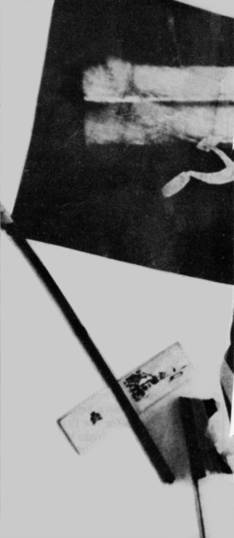
Weapons and flags captured in Nha Trang, Tet '68.
|