|
Maurice L. Brakeman
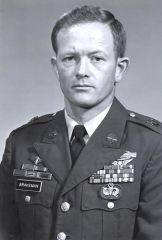
I was born Aug 1942 in Antioch, CA, near Oakland Bay
and was preceded in birth by my older brother Errol, who was born in
Newcastle, Wyoming the year before.
Our father had gone to the bay area to find work in the shipyards. After
the Jap attack on Pearl Harbor, many of the ships damaged or sunk there,
were towed to San Francisco and Oakland Bays to be repaired and
re-commissioned. Dad enlisted in the Army in June 1944 and this, with the
growing Jap threat to the area, caused Mom to move back to Wyoming with
her parents. When the war ended in Aug 45, Dad was part of the Army of
Occupied Japan. He was discharged in Jan 46 and met the family in Igloo,
SD, an Army Ordnance Depot, where mother had a job. He was employed as a
bus and truck driver. In 1948, he used the GI Bill and went to radio
school. In 1949, the family moved to Gordon, NB, where he set up a radio
repair shop and that is where I went to school and graduated.
I graduated from Gordon High School in 1960 and worked at carpentry until
Mar of 1961, when I enlisted in the Army for three years. My brother
enlisted shortly after I did. The US Army is a way of life in our family,
so it was not a big decision, it was expected. My Grandfather was in WW I,
4 of moms 5 brothers were Army, 2 in WWII, one in Korea, and the youngest
in Viet Nam. The oldest one couldnt enlist because he only had one good
eye. One eye was blinded when a cartridge discharged while being loaded.
I took basic at Ft. Riley, KS and Signal AIT at Ft. Ord, CA. I finished
AIT with an MOS of Field Wireman/Pole Lineman. We also learned how to
drive trucks. After graduation, a lot of us who had Far East options on
enlistment, went to the overseas replacement center at Oakland Army
Terminal. After an eternity, we all loaded onto a troop ship and spent 5
days getting to Hawaii.
I was assigned to Commo Plt, HHQ Co, 27th Inf Bde (Wolfhounds), 25th Inf
Div, at Schofield Bks. They didnt need any more wiremen so they sent me
to the Div signal school and made me a radio operator. I was assigned to
that platoon for the rest of my 3 yr hitch, with a couple of exceptions.
In 1962, the Wolfhounds went on a SEATO exercise to Thailand where I got
my first taste of Far East culture. We were there for 5 months at the
request of the King and Queen. During this time, I had a chance to replace
the jeep driver of the Bde CO. He was Col William A. (Bulldog) McKean. A
great CO and later to command the 5th SFG in Viet Nam for a year. He was
an old airborne troop from WWII.
In mid 63, the division started sending volunteer Shotgun platoons to
Viet Nam for 3 mos TDYs. They supported the 52nd Avn Bde which did not
have door gunners as part of their TDA/TOE. The volunteers were supposed
to come from the line companies. I griped and moaned until the Colonel
put me on the 2nd bunch to go. I learned to shoot the A6 and M60 MGs in
training before we went to Nam. Our platoon replaced the one at Camp
Holloway at Pleiku, home of the 119th Avn Co. We were there from Sep to
Dec 63, during which time Pres John Kennedy was assassinated and SVN Pres
Nhu was also killed and we didnt know if we would be run out of country
or not. During this short 3 months, (they wouldnt let you extend), I saw
more dead people, as a result of combat, than I did my other 3 trips to VN.
I mention this because later on in my career, I was told by an SF troop in
Project Delta, that my 3 months as a door gunner didnt count as combat
time because I was a leg and wasnt on the ground with SF. Im glad this
individual was a loud mouthed exception.
Footnote: During this assignment, I earned 3 Air Medals. I am more
proud of these than any other medal I received in my Army career; maybe
because I never earned a valorous award. These AMs were awarded at a time
when a man had to be assigned to an aviation unit, be on flight status and
drawing flight pay, and be a member of a crew. This other criteria also
had to be met, ie; 25 hours of flight time, plus 25 CS-1
missions. Missions were classified as Combat Support 1, 2, or 3. CS-2 & 3
were 'ash and trash'. CS-1 was a mission in direct support of ground
forces; either inserting or extracting them from enemy held areas, and/or
supporting them with ARA fire. After this assignment, I never applied for
another Air Medal, even though I flew a lot of hours during later
assignments.
This first voluntary assignment also was my first contact with SF
personnel. We flew to many SF A camps in II Corps, picked up wounded,
delivered supplies, flew in replacements, etc. I had the opportunity to
spend a couple of week-ends at the camp at Duc Co. MSG George Manual was
the Team Sgt. The team was TDY from the 7th Grp. I liked them so well and
learned enough about SF that I wanted to be one of them.
When the platoon got back to Hawaii, the Bde was preparing to go to
Okinawa on Exercise Quick Release. I was getting short and had to talk
fast in order to go with them. The 1st SFG was the aggressors. Again I had
a chance to see SF in action and it just reinforced my opinion that they
were the best our Army had. Our tent camp was set up just off the end of
Yamatan DZ and the 1st was conducting a jump school. Watching them jump
from C-130s while we were standing in breakfast chow line encouraged me to
want to do that too. That was in Feb 64. I mustered out in Mar 64 and went
home. Got a job and met my first wife in my home town. I re-enlisted after
86 days for Airborne and Special Forces. Because I went back in before the
90 day cut off, I retained my rank of SP/4. I graduated from jump school 4
Sep 1964, went home, got married, and we drove to Ft. Bragg. My weapons
class had two other men in it whom I was destined to meet again; SSG
Walter Simpson and SSG George Brierley, both Korean vets.
I was the only one in my class who got orders for the 10th Grp in Bad
Toelz. I decided to go because my wife was pregnant and I might not get
another chance at Germany. There were lots of guys trying to buy my
orders. We got to the 10th in April 65, I was assigned to B Co, ODA-17, at
Prinz Heinrich Kaserne at Lenggries. The Tm Sgt was an old WWII Marine;
MSG John T. Edmunds. A finer SF soldier never lived. He was an old White
Star vet also.
He told me in order to be permanently assigned to the team and since I had
not yet attended an NCO Academy, I should go to the 7th Army NCO Academy
at Bad Toelz. This Academy was considered the toughest in the Army and I
had my misgivings. John also told me if I graduated with honors, I would
make Sgt E-5 on my graduation day. I volunteered, graduated, and on that
day I was made E-5 Buck Sgt. I was the only SF student in a class of
over 200. I was the proudest young NCO in the Army.
I stayed with B. Co. for 18 months of a 3 year tour. During this time I
made E-6, my team attended small boat training in Italy, I learned how to
snow ski, went on two survival exercises in England with the 22nd SAS, and
instructed on the weapons committee. All in all it was a very good 18
months. But I was getting anxious to get back into the war. Lots of guys
were getting orders for VN and the 10th had to down size. We werent
getting replacements, so the Cos broke up the lower number ODAs and
reassigned the men to higher numbered teams. Late in 1966, I went to ODA
19, whos Tm Sgt was MSG Calvin Thomas, another great NCO.
I need to tell the amazing story about our commo supervisor on ODA 17, SFC
Bob Charest. He is still a very good friend of mine today.
In Nov of 1963, our chopper was flying back to Pleiku from an A Camp way
down south and we flew over the Camp at Cheo Reo. We got a call asking us
if we would pick up a wounded advisor. Naturally, we landed and picked up
a litter casualty, unconscious, heavily bandaged, with IV drip, and
covered with a blanket. All the way back to the B Team at Pleiku, I
watched this guys face. He looked dead; very pale and obviously very bad
shape. Hed been shot 3 times; in the chest, abdomen, and leg. I didnt
think hed make it. I never knew his name or if he had lived. We dropped
him off and that was that. I had wondered about that guy many times and
his face was stuck in my memory.
The first day I walked into ODA-17s team room, John Edmunds was
introducing me to the team and he got to the Sr Radio Operator, SFC Bob
Charest. I was shocked but I had to be sure. Were you in Nam in 63? Yes.
Were you on the team at Cheo Reo and wounded in Nov? Yes. It was him !
We were both amazed at how small a world it is. He had no recollection of
me, of course, but we became good buddies in a second.
I had put in my papers for a VN assignment and in Dec 66, I and the family
flew home in time for Christmas. I arrived at 5th SFG Hq in early Jan 67.
I had heard about Project Delta, B-52 and that MSG Tom Stamper was a
leading NCO there. Tom had been in my company in Germany and he was well
liked and respected. I didnt know what the Project did but it was
supposed to be dangerous as hell, so being a young hard charging SF troop,
I volunteered. When I got there, I was assigned to Recon section and was
surprised to see SSG Simpson and SSG Brierley there also.
It is a known fact that, at the time, there was a clique in Recon and if
you didnt laugh at the right jokes or suck up to the right people, new
guys were voted out by a self appointed kangaroo court, consisting of a
few guys who considered themselves experts in recon. The new men were
sent packing out of the project or to another section. All this was
unknown by the newbie and even before he went to an FOB. I didnt pass the
vote but SFC Joe Markham saved me. He came and told me about it. He said
everyone deserved a chance to prove himself first. I was very grateful and
swore to myself to prove I could do the job and justify his faith in me.
The man who seemed to be running this court, later became a good friend
and admitted to me he had been wrong.
I loved the Project and the people in it. I understood the importance of
the mission and put my heart into it. FOBs followed, like Kham Duc, An
Lao, and Hue Phu Bai. It was on a recon just south of the Ashau with
George Brierley that I was hurt on insertion. We jumped approx 15 feet
onto a steep hillside. I landed on a stump of a large punji stake or
growing bamboo; still dont know which. Luckily, it had been cut off close
to the ground by the rotor blades. It dead centered my rectum and pinned
me to the hill. I couldnt get up so the tail gunner pulled me off of it.
The hole 1 ship came back and dropped the 30 ladder. I still had all my
gear and I climbed to the skid but couldnt pull myself in and I was too
weak to let go long enough to snap link myself to a rung. The crew chief
came to the starboard side and pulled me in. He saved my life and I never
saw him again, but I knew his last name, rank, and his face, and after all
these years, I finally found him in Wisconsin, last year, but that is
another story.
My initial surgery was at the Marine aid station at Phu Bai airstrip. Then
to Da Nang and on to the States. I spent 4 months at Fitzsimmons Army
Hospital in Aurora, CO. During this time, Jay Graves and Mark Strick
stopped to visit me on their way home on extension leaves. I will always
be thankful to them. My oldest son was born while I was on convalescent
leave at home. The docs put me back together well enough that I could
re-enlist.
Thanks to Mrs A, I went to Spanish language school at DLIEC and was
assigned to the 8th SFG in Panama. I was lucky and got the team that Joe
Singh had. Joe was a good team sgt. and a recent recon alumni of Project
Delta. I stayed in Panama 9 most of the tour as an instructor at the USARSO
NCO Academy and instructed in land nav, compass, and survival. While
there, I also made SFC E-7. My first wife went off the deep end in Panama
and I had to go back to the states on a compassionate reassignment.
I took my two children to my folks in Nebraska and reported in to Ft.
Carson. I was assigned to a leg Armored Cav outfit but never did see it.
While in-processing, the personnel NCO told me I could go to an airborne
outfit that had just been assigned to the post. It had first priority on
Abn qualified troops. That was the best news Id heard in a long time. I
reported to the newly designated B Co, 75th Rangers. The acting 1st Sgt
was an SFC Attaway and was an old SF troop on his way back to Viet Nam. I
took a recon platoon as Platoon Sgt and really enjoyed it. Then Attaway
left and since I was the ranking E-7 in the company, I took over as acting
1st Sgt for the rest of my 9 mos there. The company was originally C Co,
58th Lrrp Bn, in Mainz, Germany, but was re-forged to the States. They
still wore the old Bn DI (crest) and 7th Corps patch w/Abn tab. (See photo
below). I had already requested assignment back to 5th SFG, so as soon as
my divorce was final in Jan 70 and a E-8 MSG came in to replace me, I was
on my way back to VN.
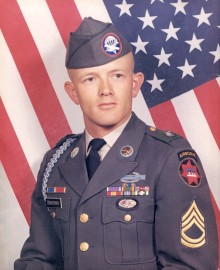
I arrived back in country in Feb 70 and was in processing at 5th SFG when
I heard the Project was at their FOB in Camp Bunard, in 3 Corps. I got on
the radio and talked to MSG Robinette, who I knew from 67 in B-52. He got
hold of the Grp SGM and persuaded him that I didnt need to go to the
COC course on Hon Tre and that he needed me at Bunard ASAP. So I was on my
way; back to a job I knew, with men I trusted with my life, doing a job I
believed in and knew was vital to the war effort. Like so many of the guys
I knew from before, I was shaking the dice again. It had become a gambling
game.
At Bunard, I met Jay Graves again and some other guys I had only heard
stories about, to include St. Laurent, Joe Alderman, Gary Nichols, and
Sammy Hernandez. The operation progressed around the area of the Song Dong
Nai, a river with many ox-bows running basically through flat terrain
with a few low hills. Because of its shape on the map, often referred to
as the big and little penis area. I reconned with Don Rodgers and
several times with Gary Reagan.
When we finished at Bunard, the Project went back to Mai Loc in I Corps
They had been at Mai Loc the year before, so it was familiar ground to
them. By now, it was clear that the Projects days were numbered. My last
recon out of Mai Loc was with Roy Sprouse and it was the last recon of
Deltas history. I think there were a couple of short Ranger operations
after that. We got the word that Project Delta was closing out. We would
go back to Nha Trang and phase out. The men would be re-assigned to other
units. Most of them that had time left went to SOG.
I went to the 5th Mobile Strike Force, B-55, in Nha Trang. The last 8
months of my tour was with them, but their days were also numbered. I took
over 4th Co, 2nd Bn, A-504 under Cpt Frank McNutt. He was killed, along
with a couple of yards, later on an operation for the Marine Corps. Cpt
Bucky Burruss had 1st Bn, A-503. He and Frank were the best of buddies.
All operations ceased by Nov and the yards were dispersed to ARVN units,
mostly Rangers, some to RFPF units in the hills at what used to be A
camps. Our war was winding down. The politicians were cutting their
losses, turning their backs, and tucking their tails on Viet Nam. They
called it Vietnamization of the war. We all knew it was a joke.
I went home in Feb 71. I had gotten remarried on a leave stateside during
my time with B-55 and now just wanted to spend some time with my family. I
got an assignment as an advisor to C Co., 19th SFG (NG) in Missoula, Mt. I
stayed there 3 years. I loved Montana and that was the longest I had
stayed in one assignment since I had been in the Army. I had maintained
contact with a buddy of mine from the Mike Force, SFC Johnson Clark. He
had wrangled an assignment to JCRC (Joint Casualty Resolution Center) in
Thailand and wanted me to try it. Note: The field teams of JCRC were all
SF, even though there were to be no SF in SEA according to the Paris Peace
Accords, so they couldnt wear the green beret.
By then, I was getting itchy feet and I put in for it. They were in the
process of phasing down too so my chances were slim but lo and behold, I
got it. I got to NKP in Nov 74. JCRC had their buildings on the airbase at
Nakhon Phanom, which had been a SOG launch site during the war. In Dec, we
packed up and moved south on the coast to an Army camp on the beach called
Samae San. We did some training but no actual operations were conducted.
In early Feb of 75, the field team Cmdr, LTC Sully Fontaine, approached me
about going to JCRCs office in Saigon to work with the SF desk
officers, who were working out of the consulates in the 4 Corps areas.
They wanted someone with combat experience, who could work with the
indigenous to recruit them to go to crash/burial sites and take pictures
and snoop around. All this was to aid in the recovery of KIAs (BNR-body
not recovered) and resolve some MIA listings. It was a worthwhile endeavor
and I felt privileged, so naturally I volunteered to go. We only wore
uniforms one day a week.
The office was located in the DAO building (pentagon east) and compound
next to Ton Son Nhut air base. I started working with an Air Force MSG on
the files the office had, which were a complete mess. During this time, I
had a chance to go on the regular Friday, 4 party, C-130 flight to Hanoi.
This was an interesting trip and one I never regretted but it was tough to
be anything but hostile to them. Right after that, the NVA made their push
to take over the South and were successful beyond their wildest dreams.
Without American units and advisors to ARVN units, discipline collapsed,
morale dropped to rock bottom, and panic set in. The whole population was
trying to get to Saigon, one way or another and the ARVN soldiers and
Marines would kill any civilians who got in their way. No one knows how
many refugees were killed by soldiers in Da Nang. They ran over them with
tanks trying to get to the few boats headed south. It was a nightmare of
epic proportions.
This was when I met Cpt George Petrie, a Son Tay raider, who had left 4
Corps and came to the office in Saigon. We all knew it was just a matter
of time before the bad guys had it all and we would have to evacuate
Saigon. The ambassador and his staff had their collective heads in the
sand and wouldnt believe it. DAO Cmdr, Gen Smith, decided to take matters
in his own hands and prepare for the worst without the knowledge of the
civilian population. He appointed Cpt Petrie to carry out a plan. George
asked me to help him, along with an American warden of Saigon. On a
Sunday, we surveyed the rooftops of every hotel housing Americans. It was
tough because we couldnt tell the occupants what we were doing. I was the
photographer. This was to prepare for the helicopter evacuation of US
citizens and friendlies. We knew, when the time came, the streets would
be impassable and ARVN troops would be shooting Americans trying to
escape. The rest is history. There have been documentaries, movies made,
and books written about that evacuation, but there was one incident that
there was not much said about in the news. That was the crash of the so
called baby lift C5A. I saw George Petrie again at SOAR 2003 and he said
that he was going to write a book about the evacuation and the crash.
There was a group of women who worked at the DAO compound, whose offices
were closing and some other female dependants who were going home. There
were about 30 of them. George and I were detailed to help them clear the
compound and get on the flight. We split them into 2 groups and we each
sheparded a group through the clearing process. When we got them to the
Galaxy, it was being loaded with over 200 babies from a Catholic
orphanage. They were just sat on the floor in rows in front of a huge pile
of Pampers. A couple of them were in incubators in the upper floor with a
couple of nurses. 90% of them were Amerasian. Our women were strapped into
seats against the fuselage on either side.
It took off without incident but at about 10,000 ft over the South China
Sea and after pressurization, the clam shell rear doors blew off sucking
the crew chief out and damaging one of the stabilizers. The pilot turned
around and tried to make it back to Ton Son Nhut. He was losing control
and altitude fast. At ground level, the landing gear hit a huge dike and
were torn off which started the shredding of the bottom of the fuselage.
Wreckage and bodies were burned and strewn for about two miles in rice
paddies and shell craters.
George called me and asked me to go with him to try and aid with rescue
and identify remains. We caught a Huey out to the site and started the
process. One thing that made the job doubly difficult, was that local ARVN
units had swooped down on the site and stripped all the bodies of
valuables. Rings, watches, necklaces, any kind of jewelry was gone. Purses
had been emptied. All ID was gone. We didnt dare try and stop them. We
continued until dark and went back out the next morning and picked up
pieces all day.
Of the women we put on the bird, an 18 year old daughter and another girl
dependant about 7 years old survived without a scratch. A couple of babies
survived because they were in incubators in the cupalo on top. Most of the
crew survived and a nurse or two. At the end of the second day, I was
pretty much out of commission. I and a guy who had flown in from CIL Thai
had been sifting through craters looking for bodies and the water in them
was covered with red hydraulic fluid. We didnt know it but that stuff is
highly caustic. We started burning from the waist down and blistering. By
the next day, all my skin had peeled off from my waist down. To this day,
I have not heard whether the crash was caused by sabotage or not.
To make a long story shorter, I left 8 days before the NVA raised their
flag at our Embassy. George stayed until the very end and then flew out to
one of the carriers. As I flew out of Ton Son Nhut back to Thailand my
mind was numb. All the years I and my buddies had spent in this country
fighting for what we believed in was for naught. What had we gained? What
good had we done the South Vietnamese? How many universities and colleges
or hospitals in America could have been built with the billions spent
there?
Our mission as a unit was over and when Saigon and Phnom Penh fell,
thousands of refugees fled to Thailand. Some flew aircraft right to Utapao
AFB just up the road from Camp Samae San. Our unit set up a refugee camp
at Utapao and I spent the rest of my tour working at the camp. I made MSG
E-8 that summer and took over as the Field Team NCOIC. I finished my year
in Thailand and went home for Christmas of 75.
The 10th SFG in Bad Toelz had slots available so I and the family PCSd to
DLI in Monterey, CA for German language school. We had quarters at Ft. Ord.
It was a good six months that was very enjoyable. I now had three children
and my last son was on the way. Matthew was born right after getting to
Bad Toelz.
I had always wanted a team of my own and the only team available was
ODA-7, the SADM team. I didnt like the nuclear surety program but there
was no choice. I had the team for about a year and a half. The mission of
the team required that we have HALO capability. None of us were HALO
qualified. We started training. On my 4th jump, I accidentally activated
my reserve at terminal, trying to reach the mains red ball handle, which
had come loose from the main lift web and was flapping behind me. The
opening shock about broke me in two and really screwed up my back. I was
in the hospital for a few days until the feeling came back to my legs and
I could walk again. Some pieces were broken off the spine. As a result, I
wound up at a desk in the Group S-3 until I left the 10th in July of 79.
When I left Germany, ODA-7 still had not become HALO qualified.
I got a job in the ROTC Dept at the University of Idaho in Moscow. I was
the Opn NCO and had a great SGM and CO. SGM John Shearin was an old SF
type. He had just made E-9 and he spent another 2 years in so he could
retire at that grade. I could have taken his slot but I had back surgery
to remove a herniated disc, I couldnt jump any more, so I couldnt hold a
regular SF job. I had my 20+ in and decided to hang it up. I officially
retired on 1 Aug 1981.
My years in the Army and especially my time with SF in Project Delta were
the best, most memorable, defining years of my life.
I went on to do many other things. I took the GI Bill and went back to
school and graduated from college with a BA in Ind Tech and a minor in
Earth Science in 1986, worked as a sawyer for a gypo logger for a summer,
then lived and worked in the mountains of Montana in the timber industry
for over 2 years. Then to Kwajalein Atoll on construction of missile sites
for 6 months. I worked for Western Geophysical in the middle east in 90
and 91. The Gulf War started when I was in Abu Dhabi. Went back stateside
in June 91. Worked in Deadwood casinos as a cashier for a while. In Apr 96
I went back to work for Western Geo in Kuwait. After almost 2 years I
fought to be transferred because of a developed hatred for oil rich Arabs.
I was transferred to the Latin American Division and worked in Trinidad,
where I met my last wife. Had a blow up with the boss there and went to
Brunei for 2 months to cool off. I then went to Ecuador where we were
run out of the upper Amazon by a tribe of Indians called the Waranya, so I
wound up on a crew in Peru on the upper Amazon for about 3 months. When
that job was finished, the company wanted to send me to the North Slope of
Alaska. I declined and flew to Trinidad, picked up my gal and flew home. I
settled in Hot Springs, SD, where I am now, married and divorced my last
wife within a year. I live a peaceful life now with my two cats, work on
my place, build wood projects in my shop, shoot and reload for my beloved
guns, and get my deer in the fall. Sometimes I go fishing.
My highlight of the year is when I go to Vegas and see my buddies from
Project Delta again.
Maurice Brakeman Photo Collection:
1967 and 1970
BACK
HISTORY

|