|
Stay Behind
by Steve Carpenter (Delta Recon 69-70)
Some operations lasted longer than a few weeks or a
month. Such was the series of operations run out of the FOB at Mai Loc
from August to November, 1969. The FOB was set up a half mile or so from
the front gate of A-101 at Mai Loc, known as the gateway to the north. The
A camp had been plagued with a steady stream of thefts, deceptions and
attacks from local insurgents. It wasnt long before rockets, small arms
and mortars were directed at the Delta FOB, the helicopter pads, and at any
aircraft attempting to take off or land from the small air strip. When
some new volunteers arrived in September, they were taken on a local
mission to prepare for the real thing. Led by D.J. Taylor, the group
encountered a group of local bad guys engaged in hiding arms pilfered from
the A Detachment. An engagement followed in which one of the new guys, Tom
Crosby, was shot in the neck. He was saved by the brilliant actions of
medic Dennis McVey, who managed to stop the bleeding from a severed
artery. All this to say that it never got really quiet at Mai Loc.
In the fall of the year, the weather became such that aircraft couldnt
support the Projects mission. Low cloud cover, steady rain, and wind all
added up to reasons for Delta to stand down for a couple of weeks in Nha
Trang. It also gave the CO time to straighten out the credibility problem
that seemed to persist with the conventional units we were OPCON to. They
didnt want to believe or react to the real time information that the
teams provided. The FOB could not be left unguarded or unattended, and so
four young Recon guys volunteered to stay behind and keep an eye on
things. A company of the Projects Ranger Battalion also stayed near the
compound to provide security. The four volunteers included SSG Jim
Thornton, SGT Chester Howard, SGT Bob Archie Inscore, and me. The
compound consisted of a few tents that housed the Recon, Staff, and Commo
personnel, a briefing tent, and the TOC tent. The compound perimeter
consisted of multiple coils of concertina wire, some noise makers and a
few claymores. A mortar pit was located close to the Recon tent area, as
were several metal Conex boxes used to store rations and equipment. The
routine on stay behind was pretty simple: somebody manned the TOC at all
times, a few random inspections were done every day and night, and the
rest of the time was spent drinking beer, staying dry and playing cards.
The excitement of the day was lifting the cargo pallets in each tent to
determine how many venomous snakes had sought refuge from the wet weather.
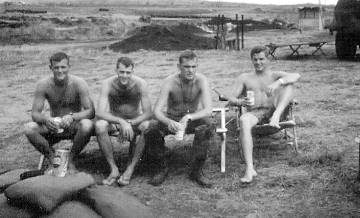
L to R: Chester Howard, Steve Carpenter,
Jim Thornton, & Bob
"Archie" Inscore, after the big boom.
One evening, as Jim Thornton manned the TOC, Chester, Archie, and I were
aroused by the sound of small arms fire and radio traffic from the Ranger
company requesting fire support. As the qualified mortar man, I grabbed my
weapon and web gear and ran to the mortar pit and began to unwrap the 81
mm mortar and position it for use. Chester clambered to the top of a conex
container and began to relay fire requests to me from the radio. The call
for fire put Chester on a straight line between the mortar pit and the NW
perimeter that was apparently being attacked. He called out a range; I
positioned the tube, charged the round and called fire in the hole!
Although on a straight line path toward Chester, the mortar round travels
in a high arcing trajectory enroute to its target, and would pass well
overhead. Several revolutions out of the tube, the round loses the locking
pin on the detonator and arms itself. The first round, a white phosphorous
illumination round, exited the tube with a bloop and traveled the
twenty feet to Chesters conex in very slow motion. Chester turned toward
the pit as the round launched and watched it come slowly toward him like a
slow pitch softball, and hit the side of the conex box just inches below
his feet. His eyes grew to the size of dinner plates and he stammered his
way through some kind of exclamatory expression replete with four letter
expletives. I began to laugh at the surreal image of Chester dancing and
swearing in the strobe like flashes atop the conex box. I charged another
round and sent it his way, with the same result. By this time the person
on the other end was calling for High Explosive rounds, and so I complied.
This time I changed the charge and the round hit the conex two inches
higher toward Chester. By this time, I could hear Archie laughing, and I
was becoming hysterical with laughter. I quickly grabbed a pinch bar and
opened a different box of rounds, took the charges from that box, and
started again. This time almost everything went where it was supposed to
go. After another fifteen minutes of illumination and HE fired on the
perimeter, the fight was over. A total of eleven rounds lay at the base of
the conex container, the product of charges rendered useless by the
humidity. By this time Archie and I were laughing so hard we were rolling
in the mud, and Chester joined in.
Early the next morning, we gathered at the pit to assess our next move. We
cautiously transported the enabled but unexploded rounds to the bottom of
the deep gully that ran just north of the recon tents and stacked them
neatly. I then placed five pounds of C-4 under them with a thirty minute
delayed fuse and retreated to the recon area to wait it out. The four of
us each cracked a beer and sat on a cot, wondering aloud how big a bang it
would make. When it finally went off, we were apparently not the only ones
impressed with the magnitude of the bang and the ensuing cloud. Within
minutes, a jet from Quang Tri was flying over at low altitude asking if we
thought wed been nuked. Thornton replied in his slow, laconic style,
Nope. Just a couple of kids havin fun.
HOME

|