USASOC honors clandestine SF unit from Vietnam War
By Spc. Tony Hawkins
USASOC PAO
FORT BRAGG, N.C. (USASOC News
Service, Oct. 28, 2008) One of the most decorated units in Special
Forces history was honored by the U.S. Army Special Operations Command
in a ceremony here, Oct. 24.
Project Delta, Detachment B-52, 5th Special Forces Group (Airborne), the
most decorated single unit in the Vietnam War, had a memorial stone
dedicated in their honor and placed in the Memorial Plaza at the USASOC
headquarters. Lt. Gen. Robert W. Wagner, commanding general of USASOC,
hosted the ceremony.
(Click on photo to enlarge)
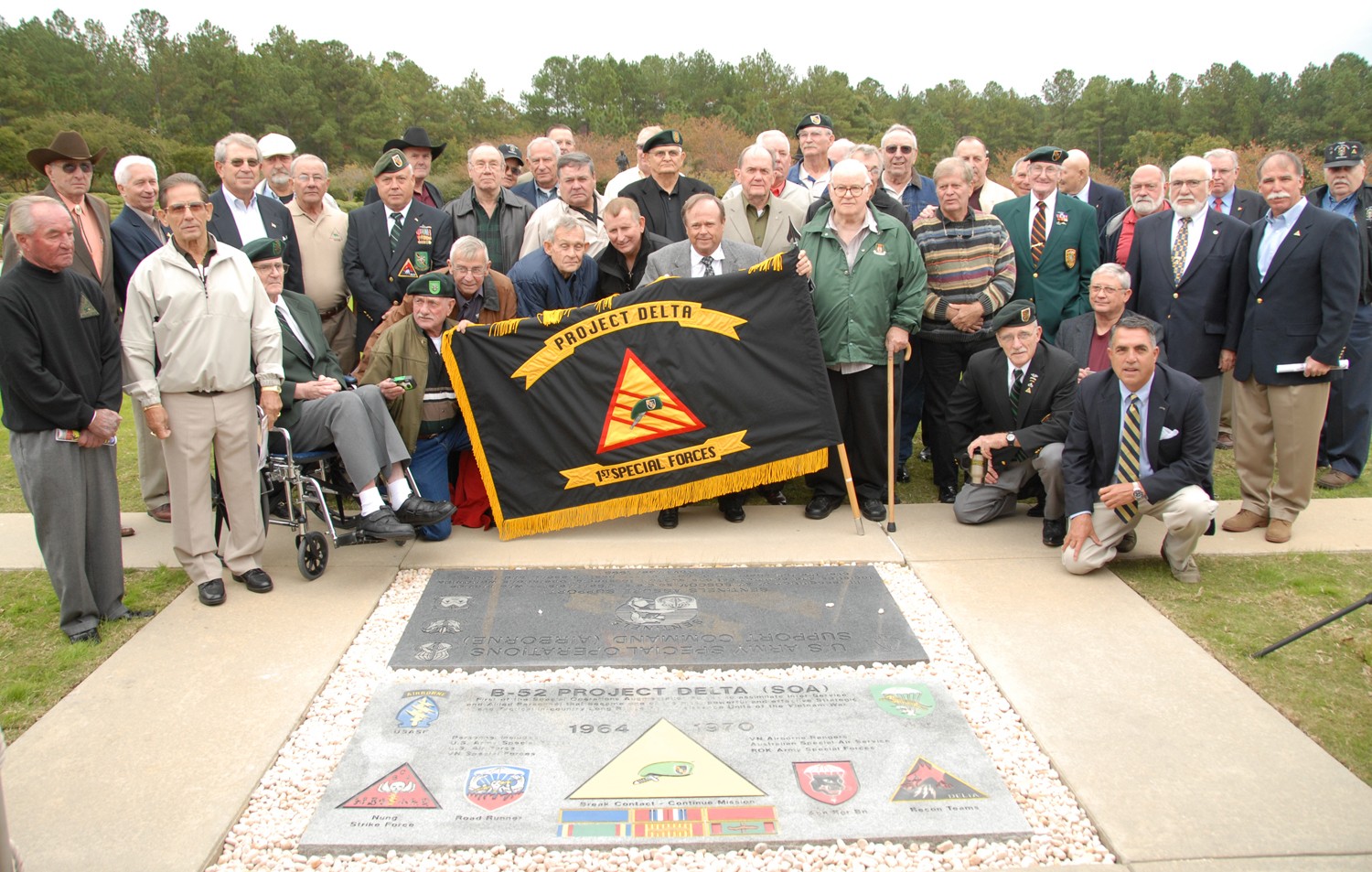
More than 50 members of Project Delta proudly display their unit
colors Project Delta was a covert Special Forces operation in
Vietnam which began May 15, 1964. A single SF detachment, B-52,
was tasked with training the Civilian Irregular Defense Group
and the South Vietnamese Special Forces, known as the Luc Luong
Dac Biet, in conducting long-range reconnaissance patrols in
uncontrolled and enemy territory. (Photo by Spc. Anthony
Hawkins)
|
Today we honor you, the
members of this heroic unit in Vietnam, Wagner said. Your
accomplishments were invaluable. You operated at the tip of the spear
before the term was coined.
Project Delta was a covert Special Forces operation in Vietnam which
began May 15, 1964. A single SF detachment, B-52, was tasked with
training the Civilian Irregular Defense Group and the South Vietnamese
Special Forces, known as the Luc Luong Dac Biet, in conducting
long-range reconnaissance patrols in uncontrolled and enemy territory.
The operation actually started as Project Leaping Lena in early 1964,
which involved selected teams from the 1st Special Forces Group
(Airborne) in Okinawa, Japan, and 7th Special Forces Group (Airborne)
Fort Bragg, N.C.
Like all great inventions, Leaping Lena, and later Project Delta, was
created to solve a problem, said Alva D. Greenup, a retired Air Force
colonel who served as a sergeant on a Project Delta recon team from
1967-1968. The problem was we had many more times the area than there
were troops to control it.
Tactically, Special Forces in Vietnam provided a valuable intelligence
source, though they did not possess the offensive capability to project
any real threat to the enemy, he said. Conversely, the divisions which
were transferring into Vietnam had the offensive punch, but the enemy
could frequently avoid major confrontations unless it was to their
advantage.
The enemy could act freely in the uncontrolled areas, Greenup said.
Something needed to be done to fix these problems in Vietnam, and that
fix was Project Delta.
Shortly after the projects inception, the 5th SFG(A) began to take a
more active role using B-52 as a command and control headquarters.
Officially, it was organized into 12 recon teams consisting of 11
officers and 82 enlisted men from U.S. Special Forces. However, some
people remember it slightly different.
Theres formal military history, and then theres war stories, Greenup
said. The real truth about what we were is somewhere in between. For
instance, one thing, in my time there I never saw 12 recon teams. There
just wasnt that many people.
In addition to the American Special Forces, there were more than 1,200
South Vietnamese and ethnic Chinese soldiers divided into two CIDG
companies and the 81st South Vietnamese Airborne Ranger Battalion. One
CIDG company was the Nung Strike Force, a platoon-size, rapid reaction
force made up of ethnic Chinese soldiers. The other company was known as
the Roadrunners.
The Roadrunners were select indigenous members from various groups,
Greenup said. These soldiers showed an extra measure of courage in that
they would go undercover within a North Vietnamese unit to provide
intelligence. Once a North Vietnamese unit had been found, the
Roadrunners would be prepped and fitted with the appropriate equipment,
then inserted to link up with the enemy and collect information.
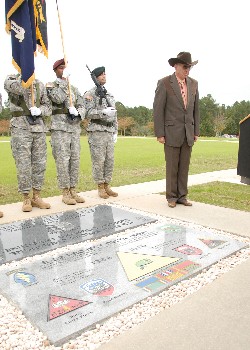
(Click on photo to enlarge)
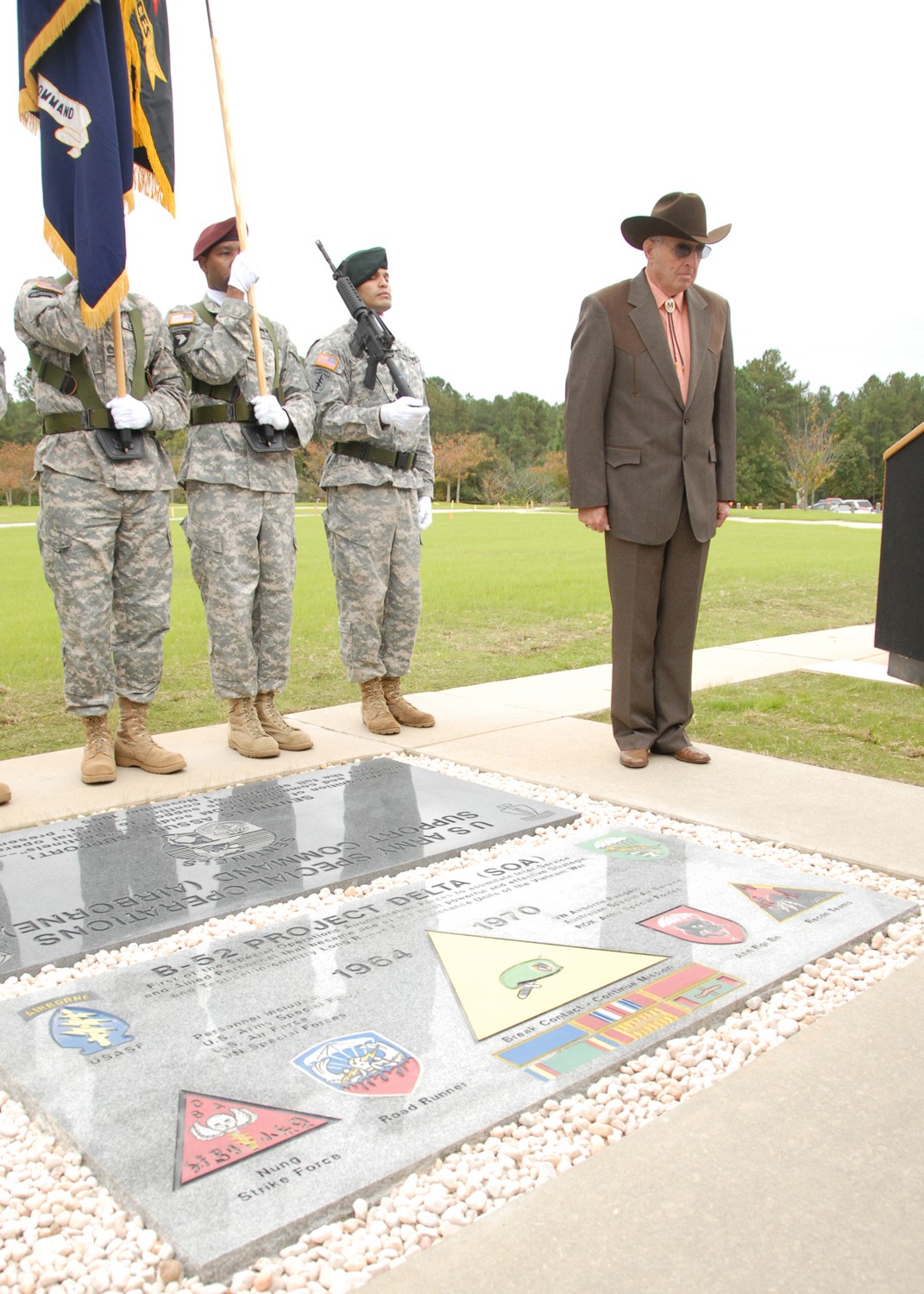
Retired Command Sgt. Maj. Alton "Moose" Monroe, a recon team
leader and NCOIC, stands by the project's memorial stone during
a dedication ceremony at USASOC headquarters Oct. 24. (Photo by
Spc. Tony Hawkins, USASOC PAO)
|
As you can imagine, this was very hazardous duty, Greenup said. These
were some extraordinary people. It was always exciting when we were
doing an extraction on a Roadrunner team. Wed go in on a helicopter and
start picking up six guys out of the woods wearing North Vietnamese
uniforms and carrying AK-47s. There were a lot of door gunners on
helicopters that would like to have cut down on them.
Delta also incorporated several other support elements into the unit,
including dedicated U.S. Air Force forward air controllers. These Airmen
were an invaluable asset to the unit, and their skills came in handy as
Project Delta enjoyed the highest priority in air support.
When a Delta FAC called for air support they got it, and they got it
very quickly, Greenup said. That gave the recon teams a powerful
wallop, and was an enormous confidence builder.
The 281st Assault Helicopter Company provided all the lift resources for
Delta, while developing special tactics and techniques to enhance the
mission of the ground forces.
Every recon guy knew the 281st were coming to get em, no matter how
bad the circumstances, Greenup said.
This sentiment was equally shared throughout Project Delta.
It was said among the project that when the 281st came to get a Delta
team on an emergency extraction, they would either get you out, or they
would all crash beside you, said Gary L. Reagan, who served as a staff
sergeant on a Delta recon team. They wouldnt quit until one or the
other had happened.
Delta was also the first U.S. Army unit in Vietnam to operationally
assimilate U.S. inter-service and allied personnel, such as the
Australian Special Air Service and the Republic of Korea Special Forces.
Although a variety of units were represented in Project Delta, the core
mission surrounded the six-man recon teams.
This was where we got the return on the investment, Greenup said. The
idea was inexpensive, efficient and turned out to be tremendously
effective.
Originally the teams were made up of six Americans, but they eventually
evolved into teams of two Americans and four indigenous personnel,
typically Vietnamese Special Forces. As the effectiveness of the small
recon teams evolved, other units were formed, such as Projects Gamma,
Omega and Sigma. The Military Assistance Command Vietnam, RECONDO School
was also developed from Detachment B-52 to train personnel in forming
long-range recon patrol companies within each division.
These teams were designed to strike deep into uncontrolled territory,
seeking out Viet Cong units and their sources of supply. Normally sent
out on five-day operations, the teams performed a wide variety of
missions, including locating enemy units, intelligence gathering, bomb
damage assessment, artillery and air strike coordination, hunter-killer
missions, special purpose raids, and conducting harassing and deception
missions.
The projects success was directly due to the caliber of Soldiers
serving in the unit and the shared professional ethos of the teams.
In the finest tradition of Special Forces, almost every man seemed to
be blessed with an inquiring mind, a strong will, an adventurous nature
and a readiness to lead, Reagan said. They approached the challenge
with a very simple philosophy: well either find a way or make a way.
Despite being the most decorated unit in Vietnam, there were very few
individual awards.
There was almost a disdain for individual awards and recognition,
Reagan said. In Delta the standard was if you were dead, missing or
seriously wounded you probably would be put in for a medal. If you came
back in one piece, that was its own reward, and in a couple of days you
could go out and do it again.
Spread across six years, Delta was small in numbers, yet it was big in
impact. The intelligence gathered provided the identities of more than
70 NVA and VC units, enabling the capture of numerous supply caches,
documents and prisoners. This information was often gained in remote and
largely inaccessible areas of the counter and was produced with minimal
casualties.
Although, as with any conflict, Project Delta did suffer its share of
casualties. The names of 29 Delta members are inscribed on the Vietnam
Veterans Memorial Wall in Washington, D.C.
Delta was officially deactivated on July 31, 1970, and the men of
Detachment B-52 went their separate ways. During its six-year history,
roughly 600 Soldiers served with the unit. Many of them continued on in
military careers, some becoming instructors for various schools, and
others returning to the Special Forces groups to pass on valuable
lessons from their Project Delta experience. One Delta member wrote and
published a tricks of the trade manual.
Rumor has it that this book is still used among present-day Special
Forces guys, Greenup said. Were quite proud that the legend lives on
with the new guys.
Of the Delta members who stayed in the military, 20 became field-grade
officers, two became general officers, including former chairmen of the
joint chiefs of staff Gen. Hugh Shelton, and 59 became command sergeants
major.
Delta attracted men from all walks of life, and when their time in the
project was over they moved on to contribute to their communities and
country in many ways, Reagan said.
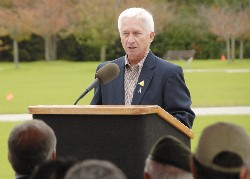
(Click on photo to enlarge)
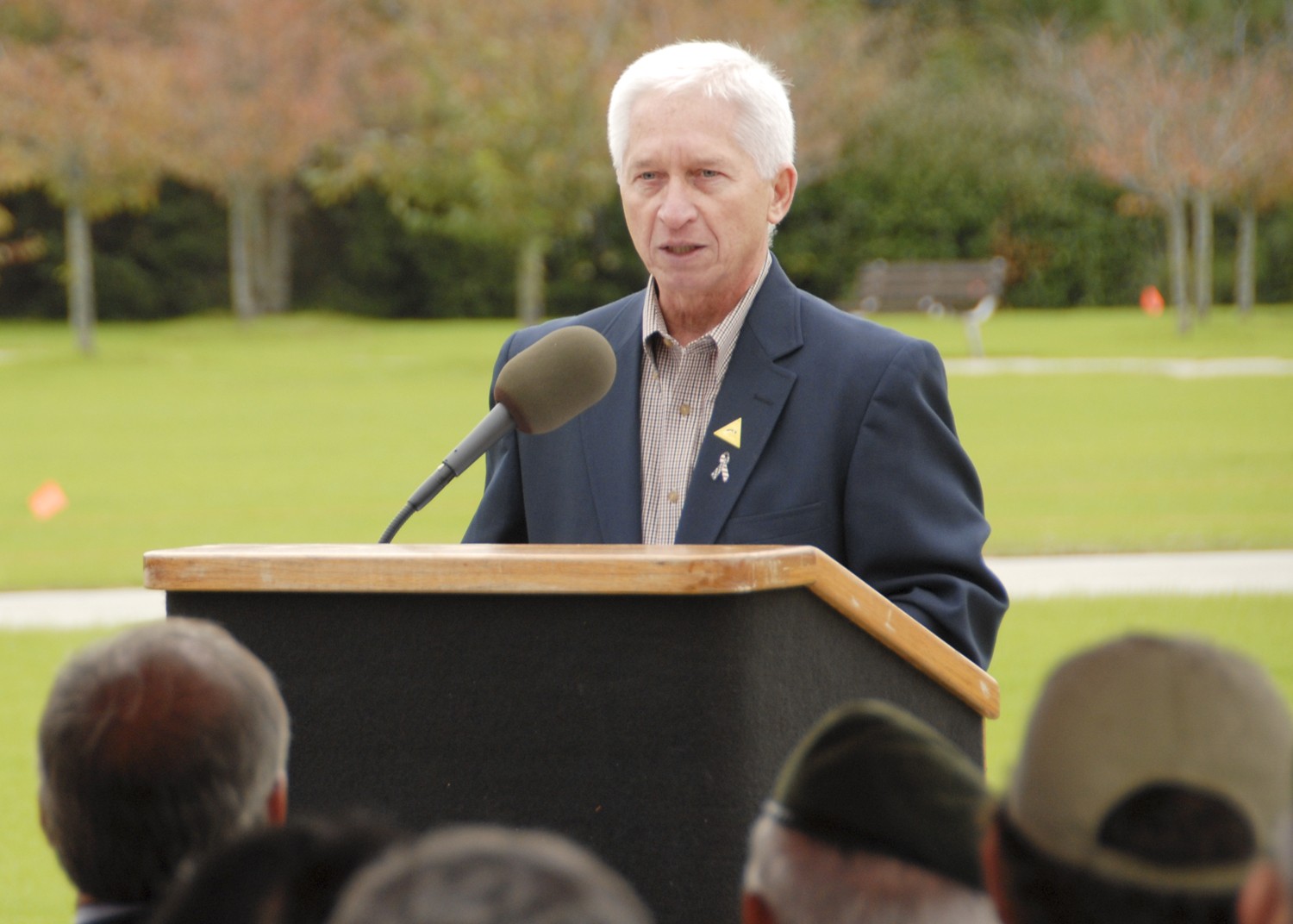
Gary L. Reagan, who served as a staff sergeant on a Delta recon
team, speaks during the project's memorial stone dedication
ceremony at USASOC headquarters Oct. 24. (Photo by Spc. Tony
Hawkins, USASOC PAO)
|
Several of the men went on to become physicians, professors and
ministers. Others went into areas as varied as law enforcement,
television broadcasting and nuclear power.
Most importantly to many of the Delta members, is that their legacy
lives on in modern-day Special Forces.
Im confident that the Project Delta members had a great deal of
influence regarding the development of the modern Special Forces
tactics, Greenup said. The legacy of Project Delta is partly due to
the extraordinary six-year history in Vietnam, and partly due to the
success of Special Forces teams carrying on the fight to our nations
enemies in Afghanistan and Iraq, and throughout other locations in the
world.
For many, Project Delta set the standard for those Special Forces
Soldiers who came after them.
You set the example and established the blueprint of the things we do
today, for all the future generations of Special Operations Forces,
Wagner said. You were young men with the skills, courage and trust in
one another to put your life at risk, with the instincts and cunning
judgment to know what to do. No bragging, no boasting, just doing.
Without the technology we have today, but with the simple courage, guts
and tenacity to never quit.
--usasoc--
HOME