|
The McGuire Rig
by Donald J. Taylor
Recon Team Leader
July 1968 July 1970
|
Project
Deltas mission during the Vietnam War was long range reconnaissance, and
as such, it depended on U.S. Army UH-1D/H helicopters, primarily from the
281st Assault Helicopter Company, to insert and extract its
long range reconnaissance teams.
When a reconnaissance team became
compromised and could not break contact with the enemy, the team would
usually request an emergency extraction, and an emergency extraction, more
often than not, was accomplished using the McGuire rig.
The McGuire rig was the method used to extract a team by rope when the
extraction helicopter could not descend low enough to either sit down, low
hover, or utilize its two 35 ladders. If the helicopter could descend
down to at least 100 feet altitude above the team, McGuire rigs were
dropped to the team and they were extracted by rope.
A McGuire rig was simply a 15 x 3 nylon strap (type A7A) fashioned into
a loop large enough for a man to sit in and with a smaller wrist loop sewn
into the A7A strap to prevent the wounded or unconscious from falling out.
The top of the A7A strap was tied to the outside (running) end of a 120
foot inch nylon rope and stowed on the left side of the helicopter
inside a Griswold container (a thick canvas weapons container). |
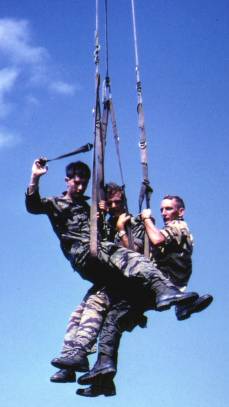
Three Project Delta soldiers ride a McGuire rig during training at Mai
Loc, I Corps, 1969
|
|
The nylon rope was S folded and secured by rubber bands to two canvas
strips that had been sewn into the inside of the Griswold container. The
Griswold container performed three functions: to keep the rope from
fouling, to protect the rope when walked on, and to protect the rope
from the sharp outer edge of the helicopter floor.
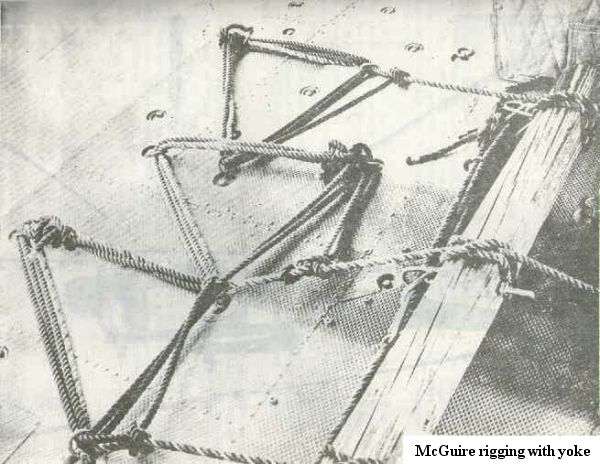
Floor of helicopter with teak wood yoke at right, ropes running
through rings in triangular fashion at left.
The inside (standing) end of the rope was clove hitched to an 6x 6x 5
teak wood yoke in the center of the helicopter floor and secured by snap
link to at least three anchor rings in the floor of the helicopter. The
yoke had three large O rings bolted into its side and was snap linked
by these O rings to floor anchor rings on the right side of the
helicopter. A sandbag weighing about 20 to 30 pounds was tied to the
bottom of the A7A strap loop and tucked up under the outside end of the
Griswold container. Three McGuire rigs were usually installed in each
helicopter.
The heart and soul of the McGuire rig system were its ropes, and good
rope maintenance was crucial to the dependability of McGuire rigs. The
inch nylon ropes were rated at 3600 pounds. After each use, ropes were
carefully inspected, and if even one thread in a rope had been damaged,
it was discarded. Each thread ran the entire length of the rope and if
even one thread was damaged, the entire rope was weakened.
|
|
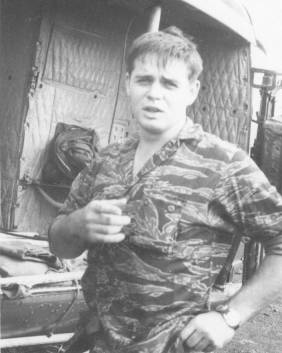
A rigged
helicopter can be seen behind Bill Dill. All that is visible is the
ladder, a Griswold container, and a sandbag. |
In the life of these 120-foot ropes, there was a 20% stretch factor
before they were no longer safe to use. Each time a rope was used, it was
stretched a little bit longer until it had lost all of its elasticity at
about 140 feet, and before this happened, it was replaced. But this
created a problem with varying lengths of rope. If a new 120-foot rope was
used to replace a damaged rope, it would be shorter than the other two
McGuire rig ropes and its rider would ride possibly 10-feet higher than
the other two riders. To correct this, the new rope was tied between the
bumpers of two vehicles and the rope was stretched until its length
matched the other two.
After the McGuire rigs had been installed in the floor of the helicopter,
an 80-foot aluminum and steel cable ladder was installed on top of them,
with 35 feet of the ladder rolled up and secured between the skid and the
troop deck on each side of the helicopter. The center of the ladder was
snap linked to anchor rings in the helicopters floor, and the ladder
rolls were attached to floor anchor rings with standard air- |
|
craft seatbelts. To release the ladders, the seatbelt releases were
kicked open, and of course, the order to release the ladders was Kick
the Ladders. After the ladders had been lowered, they could be pulled
back up to the helicopter by a rope that ran the entire length of the
ladder.
When the decision was made to employ the McGuire rigs, the rolled up
ladder on the left side of the helicopter was pulled inside and stowed on
the right side. To protect the ropes from the sharp outer edge of the
helicopter floor, the Recovery NCO would unfold the Griswold containers
and slide the outer end of the containers over this area, making sure that
the thick canvas fabric of the container was between the ropes and the
floor edge.
As soon as the helicopter had descended to less than 100 feet above the
Recon team, the Recovery NCO would pick up each sandbag and toss them out
and over the skid. The weight of the sandbag pulled the McGuire rig and
rope out of the Griswold container and down to the ground below at a high
rate of speed. It was up to the Recon team to dodge the sandbags.
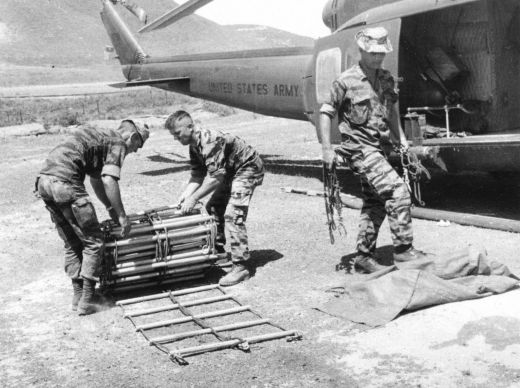
SFC Norman Doney supervises SSG James Coalson and SFC Paul
"Mickey" Spillane in the installation of an extraction ladder on a Huey at
Phu Bai, 1968. Doney scrounged the ladders from CH-47's and equipped 281st
AHC helicopters with them to extract recon teams. Doney later did the same
at CCC.
The standard composition of a Project Delta Recon team was two U.S.
Special Forces and four Vietnamese Special Forces, and it took two
helicopters to extract the team by McGuire rig. The Recon SOP for McGuire
rig extraction established that the first helicopter would lift out three
Vietnamese and the second helicopter would lift out the two Americans and
one Vietnamese. Because they had the radios, the Americans were always the
last to be extracted.
The SOP also stated that each man would snap link his CAR-15/M16 by the
carrying handle to his LBE on his right side with the muzzle pointing
forward. This arrangement allowed the team to have one-handed use of their
weapons during exfil and could return fire if necessary.
The moment the sandbags impacted on the LZ, the first three men would run
out, grab the McGuire rigs, snap link their rucksacks into the bottom of
the A7A strap loop, slip their left wrists into the wrist loop, step into
the loop, look up and signal with a thumbs up to the Recovery NCO that
they were ready for lift off. When the Recovery NCO saw that all three
were ready, he would direct the pilot to lift off. As the helicopter rose,
the ropes tightened and each man could then sit in the A7A strap loop of
their McGuire rig. They would link arms and legs as they lifted off the
ground and become one solid mass plowing through the air a hundred feet
below the helicopter. The linking of arms and legs was done in case a rope
was shot in two, as a man might be saved by his team mates hanging on to
him.
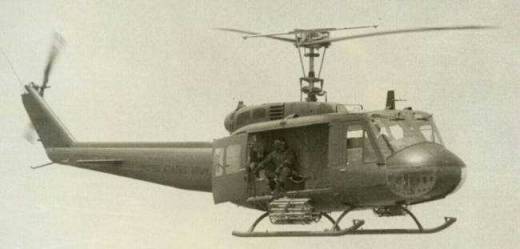
281st AHC Slick - Rigged and Ready
If a relatively safe clearing could be found enroute back to Project
Deltas Forward Operating Base (FOB), and if the helicopter had the fuel
to spare, the helicopter would sit down so the team could board the
helicopter. If not, then the team was in for a long and uncomfortable
ride, as sitting on that three inch nylon strap for any length of time
could become quite painful.
It was not uncommon for a McGuire rig ride to last an hour or more, as
most Project Delta Reconnaissance Areas of Operation (AO) were at the
maximum range of the UH-1D/H helicopter. Even with a full load of fuel,
helicopters would frequently leave the FOB with barely enough fuel on
board to reach the AO, spend no more than fifteen minutes on station, and
then return to the FOB. If the extraction helicopter used more than its
allotted fifteen minutes while recovering the team, the pilot wouldnt
have enough fuel left on board to divert to an LZ, sit down, and take the
team on board. When this happened, the team would have to ride the entire
one-hour (+-) return flight to the FOB in the McGuire rigs, and they would
frequently just barely make it back to the FOB before the helicopter ran
out of fuel.
The Recovery NCO had a machete on board the helicopter, and he was to cut
the McGuire rig ropes if the team became tangled in the trees on lift off.
If the helicopter developed mechanical problems and began to fall, he was
to wait until the team was at tree top level before he cut them loose. All
agreed that the team had a much better chance of surviving the impact with
the trees or ground than they did of surviving if the helicopter crashed
on top of them.
McGuire rigs were so painfully uncomfortable that when SOG developed
the STABO rig in 1969, Delta Recon requested that Project Delta also adopt
the system, but the request was refused. For logistical reasons, it was
determined that the STABO system was not practical for a unit the size of
Project Delta. For Project Delta to retain the capability of providing
emergency extraction for everyone in the unit, not just Recon, but every
Road Runner, BDA Nung, and Ranger would have had to have a STABO rig. If
the Project had adopted the STABO system, the unit would have had to
procure and maintain several hundred STABO rigs. With the McGuire rig,
Project Delta only had to maintain no more than 20 or 30 rigs at any one
time, and could quickly make more if needed.
|
|
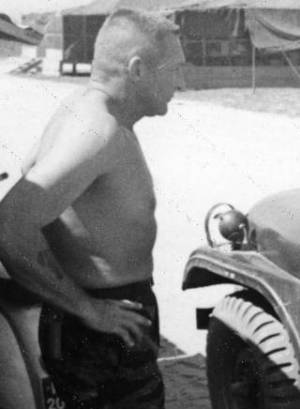
Project Delta's Sergeant Major Charles T. McGuire -
renown for the McGuire rig used to extract recon teams. |
The STABO rig was a machine stitched harness similar to a parachute
harness and was quite expensive and time consuming to manufacture. The
harness was made of similar nylon material as the A7A strap, and was worn
in the field as load bearing equipment (LBE) until it was needed for a
rope extraction. STABO harnesses were made in small, medium, and large
sizes.
To ready a STABO harness for rope extraction, two leg straps were brought
from the back of the harness up between the legs and snapped into D rings
mounted in the front of the harness. A standard issue pistol belt laced
through the center of the rig was buckled tightly around the waist of the
wearer, a chest strap was fastened across the chest, and two snaps at the
top of the harness would snap into two D rings attached to the rope
dropped from the helicopter.
When the STABO and McGuire rigs were compared, the only thing the STABO
rig had over the McGuire rig was comfort during the ride. For
practicality, the McGuire rig couldnt be beat: |
|
The McGuire rig remained in the helicopter and was not carried in the
field, as was the STABO rig. The STABO harness, when worn in the field as
LBE, was not only heavier than LBE, but it did not fit well under a heavy
rucksack, nor did it properly distribute the weight of ammunition,
grenades, and canteens and could become rather uncomfortable after it was
worn a few days.
The McGuire rig was always there when needed. With the McGuire rig, a
soldier could become separated from his gear and still be extracted by
rope. However, with the STABO rig, if it was lost it in the field, the
soldier could not be extracted unless he could find a sit down or ladder
LZ. There was at least one American in CCN who is still out there because
he became separated from his STABO rig.
And last but not least, how would the Road Runners have worn a STABO rig
with an NVA uniform?
Project Delta retained the McGuire rig until the end. They may have been
uncomfortable, but they were cheap, reliable, and effective. A debt of
gratitude is owed Sergeant Major Charles T. McGuire for creating a piece
of equipment that was just what was needed at just the right time. An
untold number of American and Vietnamese Special Forces soldiers lived to
fight another day simply because of Sergeant Major McGuires innovative
and timely creation.
Sergeant Major McGuire is alive and well and living in retirement out on
the coast of North Carolina. But not for the U.S. Armys mandatory
retirement policy, he would still be on active duty and leading another
generation of Special Forces soldiers in combat.
|
HOME

|