|
"The Last Survivor"A Memorial Day Tribute
by Roger L. Albertson
U.S. Army Special Forces 1963-1966
B-52, Project DELTA 09/65 03/66
Sergeant Major Wiley W. Gray was buried in
Arlington National Cemetery on 10 May 2001. Years earlier, he had retired
from the United States Army after twenty-one years of service that
included combat in Korea and Vietnam. I first met him in January 1966
when, then Master Sergeant, Gray had volunteered for long-range
reconnaissance patrol duty with 5th Special Forces Groups Project
DELTA. Within a few of days of his arrival, he was a member of three
six-man recon teams inserted into the An Lao Valley located in Vietnams
Bihn Dinh Province. They were the first friendly forces to enter this
valley in eight years. Their mission was to find and gather intelligence
on a suspected NVA regiment.
On 28 January 1966, the morning after insertion, Grays recon team made
light contact with the enemy. SFC Cecil Hodgson had opened fire on two
armed enemy soldiers he caught walking up their back-trail. Compromised
and moving fast through a large area of recent heavy enemy activity, the
team stopped to reassess their situation and radio a request for immediate
extraction. They were too late. A hail of small arms fire engulfed them
fatally severing SSG Frank Badolatis left arm and destroying Hodgsons
rifle. On the run, they traveled about half a mile when ambushed again. No
one was hit but the ambush split the team. Gray, Hodgson and SSG Ronald
Terry went one way while Badolati and the other two went another. Without
a radio, Gray, Hodgson and Terry were able to evade the enemy all the way
to late afternoon the next day, but thats when their luck ran out.
They had to find an open extraction site where a helicopter could be
flagged down with pen flares or florescent panels. Unfortunately, the NVA
anticipated this and had the one they selected covered. The ambush they
walked into killed SSG Terry in his tracks and separated MSG Gray from SFC
Hodgson. Gray heard one shot from Hodgsons 9mm pistol followed a minute
later by three rifle shots. That was the last he ever heard from him.
Using skill and guile Wiley Gray was able to elude his pursuers the rest
of the 29th and until about noon the next. By then the NVA had over one
thousand men in three to four man groups systematically searching for him.
Wiley heard one of these groups approaching his elephant grass hide and
waited until they were six feet away before opening up and killing them
all. Moving slowly away for an hour, he heard another group approaching.
Again he waited until they were within six feet before killing them.
Another hour later it happened a third time, again with the same results.
About this time the NVA privates that were doing the grunt work in this
hunt decided it was in their interest to slow down and be less methodical
giving him a little more room to escape and evade. And just before
nightfall, he was picked up after attracting a search helicopter with a
pen flare.
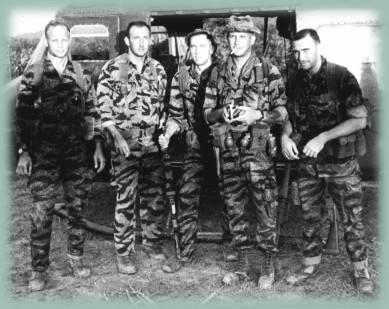
L to R: MSG Wiley Gray, SFC Cecil Hodgson, SSG Billy
McKeith
SSG Frank Badolati, SSG Ronald Terry
(photo courtesy Charles A. McDonald)
In 1994 I used Cecil Hodgsons name in a small article that discussed the
possible impact pending Vietnamese normalization could have on U.S. POWs.
This article was reprinted in other newspapers and kept by a friend of
Cecils sister, Brenda. Then last year, the U.S. Government approached
Brenda with the erroneous news that they thought Cecil and Ron Terrys
remains had been recovered. At this point, her friend gave her my 1994
article and last October she used it to locate me.
In her quiet halting voice she told me that Cecils 29 January 1966 loss
and subsequent governmental stonewall had split the family in half causing
their mother and father to divorce after forty years. Their mother, who
now suffers from Alzheimers, believed our government when they said they
had no information. Their father did not believe them and, until his
recent death, had spent everything unsuccessfully trying to get
information on his son. Also, of Cecils four children, his oldest boy
committed suicide two years ago while in the Air Force.
Brenda asked me if I knew a Sergeant Gray. She understood that a Sergeant
Gray was the last person to see Cecil alive, and had been looking for him
for over twenty years. I gave her Wileys number and just like that, he
was able to help her understand what had happened.
Amazing! Thirty-four years after being saved from death, he was able to
bring a measure of closure to a dead teammates family because of a small
article written by a governmentally frustrated citizen, reprinted
elsewhere and squirreled away for years by someone unrelated. Oh, the
power of the press
Wiley Gray died of a heart attack on 16 April 2001. He was a super guy who
stood a lanky six foot two with great looks and a devastating smile. In
1966, he refused a Distinguished Service Cross for his actions saying, I
wasnt able to save anyone but myself, and I dont deserve a medal for
that. Even at age 70, Wiley was a Green Beret poster soldier if ever
there was one. On that beautiful May 10th morning, Wileys casket was
placed on a caisson for the last mile of his lifes journey. Even the six
draft horses pulling the caisson seemed to sense the solemnity of it all.
Their heads were high and they moved with the same measured gate as their
Honor Guard escorts while the mourners on foot followed close behind
through Arlingtons tree shadowed sunshine. God, what a loss!
In the history of our nations wars there are thousands of stories similar
to this one. Each has its dead, maimed, survivors and families. We must
never ever forget, that this horrible collective loss was to keep the
United States free. This is, and always will be, the price of our freedom.
So this Memorial Day, and every day for that matter, when you see a
veteran, stop and thank him for his service. Even if he says nothing, I
promise he will be grateful. You see, for some veterans and their
families, every single day is, or will be, a Memorial Day of sorts.
BACK
HOME

|