|
History of Project Delta - Part I
INTRODUCTION
Project Delta, formally an all Vietnamese unit, organized by the Central
Intelligence Agency under the code name Leaping Lena, and trained by US
Army Special Forces, was the birth place of Long Range Reconnaissance in
South Vietnam. This unique unit was the forerunner of the famous Ground
Studies Group (OP-35), commonly referred to by the headquarters element
designation of MACV SOG, which began cross border reconnaissance, and
trail interdiction in 1966. Project Deltas reconnaissance training
program ultimately led to the creation of the MACV RECONDO School; And
from the Project Delta model, the other Greek letter projects, Omega, and
Sigma were formed. A detailed history of this magnificent unit is under
construction. Until completed, a few notes gleaned from published sources,
and edited, will be posted here.
GENERAL
In August 1950 the United States sent a small military staff to Vietnam to
assist the French in teaching Vietnam forces the use and maintenance of
U.S. military equipment furnished under the Mutual Defense Assistance Act
of 1949. Chiefly technicians, these advisers were not organized in regular
military units but functioned as an extension of the U.S. diplomatic
mission in Saigon to which they were assigned. By 1953 the United States
had between two and three hundred military advisers in Vietnam.
Created 8 February 1962, The Military Assistance Command Vietnam (MACV)
was made directly responsible for the command, control, and logistical
support of the steadily increasing number of U.S. military advisers,
technicians, and staff personnel who were being assigned to Vietnam. MACV
along with the Vietnamese JGS would ultimately become the controlling
headquarters, and assign/approve Project Delta missions. In 1965, the U.S.
Military Assistance Command, Vietnam, was serving as an allied
headquarters, and an extension of the U.S. diplomatic mission.
There always seems to be a difference between a units capability and what
it actually does. Project Delta was no exception, and like most Special
Forces units in Vietnam, Delta never utilized all the talent assigned.
Because of the dedicated reconnaissance mission, which it accomplished
successfully and with valor, Project Delta worked below its level of
expertise.
While Delta conducted missions other than reconnaissance, as illustrated
by the Vung Ro Bay operation, relief of the SF Camp at Plei Me, and Tet of
68 in Saigon; The stated mission of this organization was always special
reconnaissance in the four corps areas of South Vietnam.
Project Delta was a combined US Army Special Forces (USASF) augmented B
Detachment, a Vietnamese Special Forces (VNSF) Training Command
headquarters, and a VNSF Airborne Ranger Battalion. Project Delta usually
functioned under the Operational Control (OPCON) of a division size unit,
and the area of operations effectively covered between 2000 and 3000
square kilometers. The Project used a wide variety of ground and aerial
reconnaissance methods, and techniques to accomplish objectives.
The US operational strength was 11 officers and 82 enlisted men. Actual
strength varied, and after 1966, some excess support personnel were
attached and/or assigned.
A 105 man Civilian Irregular Defense Group (CIDG) Nung Security Company
furnished security for the Delta force. This company also had a Bomb
Damage Assessment (BDA) platoon.
The Vietnamese Special Forces (LLDB) operational strength was 20 officers
and 78 enlisted men, and ultimately became a reflection of Detachment
B-52. In addition, there was a 123 man CIDG Roadrunner Company; a
reconnaissance platoon; and the 81st (Formally 91st) Airborne Ranger
Battalion with 43 officers and 763 enlisted men. The 81st Airborne Ranger
Battalion was Project Delta's reaction force. The battalion had six
companies with four deploying on Delta missions, and two remaining in
garrison under operational control of the VNSF Commanding General (CG).
The Roadrunner Reconnaissance Company was commanded by a VNSF Lieutenant,
and advised by two USASF NCO's. The mission of this company was to conduct
clandestine reconnaissance and surveillance missions. The method of
operation was to infiltrate enemy occupied areas, and travel the roads,
trails, and paths, dressed as members of the opposition.
The BDA Platoon had 30 CIDG and two USASF NCO's. The platoon's mission was
to provide bomb damage assessment, and analysis of artillery, and air
strikes. The platoon had the additional mission of acting as Project
Delta's first reaction force.
A VNSF officer with a senior USASF NCO advisor commanded the
Reconnaissance Platoon. The platoon had 12 recon teams consisting of 48
USASF advisors and 72 VNSF personnel. Each team had spaces for six VNSF,
and four USASF personnel. In line with the Vietnamization goals, two teams
had all VNSF members. The mission of these teams was to conduct
reconnaissance, and surveillance missions in enemy controlled areas.
Requests for use of Project Delta forces were submitted jointly by the
Vietnamese Corps Commanders to the Joint Central Staff, and by the US
Tactical Zone Commander to MACV. Requests were studied at both higher
headquarters, and the Corps tactical zone having the most need, received
Project Delta, usually, for a 30-day period. The US headquarters within
the tactical zone, which was assigned operational control of Project
Delta, furnished support as required. The staff of Project Delta
coordinated with their counterparts in the OPCON headquarters. And the
area of operations, approximately 2500 square kilometers, was assigned for
the exclusive use of Project Delta.
A Forward Operational Base (FOB) was selected in the vicinity of an
airstrip capable of supporting C-130 aircraft. When the FOB could not be
located on this type of strip, a separate mission support site (MSS) was
established. Project Delta forces were transported to the FOB or MSS by
C-130's. The FOB was usually set up and fortified during a five-day
period.
On becoming operational, Project Delta used any and/or all of the
following capabilities to fulfill its mission: Long range and covert
reconnaissance in enemy controlled areas; Plan and direct air strikes on
otherwise inaccessible targets; Make bomb damage assessments in enemy
controlled areas; Use reconnaissance-in-force missions against concealed
enemy positions; Execute hunter-killer missions at night using airborne
sniper scopes and star light scopes; Recover allied prisoners of war;
Capture enemy personnel for intelligence exploitation; Rescue downed
aircraft crews; Employ wire tap procedures on enemy communication lines;
Mine transportation routes; Mislead enemy counterintelligence by deceptive
missions, mock ordnance, and dummy infiltrations; Use harassing gas and
smoke to channel enemy personnel into kill areas; Conduct photo
reconnaissance; Assist in psychological operations; and conduct airborne
personnel detector missions.
While not written in stone, Insertion of Delta Teams was usually made at
twilight using four UH1D slicks and two gun ships. These Aircraft flew to
a LZ in a line formation in the following order: one Command and Control
(C&C) slick, one insertion slick, two recovery slicks, and two gun ships.
The pilot of the C & C aircraft controlled the air operation. He directed
the pilot of the infiltration ship to the Landing Zone (LZ); the
infiltration party departed the ship by ladder, landing, or rappelling.
During the insertion, the gun ships remained on station to keep the LZ and
immediate vicinity under constant surveillance. The recovery ships orbited
with the C & C ship at a higher altitude, and were prepared to extract
personnel in case of emergency, which usually meant downed aircraft,
wounded personnel or excessive enemy activity in and around the LZ.
Assigned Forward Air Controllers (FAC) would fly in a wide orbit and were
prepared to call for air strikes. Upon completion of the insertion, the
entire formation would make at least one pass at another LZ for deception
purposes.
Reconnaissance teams practiced maximum deception techniques after
insertion. Whispered radio status reports were passed through the Airborne
Radio Relay to the FOB three times a day. Enemy sightings or other
intelligence were transmitted immediately. Roadrunner teams attempted to
deceive local enemy forces with the similarity of uniforms, weapons, and
cover stories.
Extraction procedures were essentially the same as insertions, and level
of difficulty depended upon the weather and enemy situation. FAC's went
first to the area and located the team. The C&C ship made positive
identification using pre-designated codes, and the recovery operation
paralleled the insertion procedures.
With the exception of pre-planned Ranger type missions, deployment of
Project Deltas reaction forces depended upon the extent of enemy contact.
The immediate reaction element (BDA Platoon) was the first force
committed. Next was the intermediate reaction force (a company of the 81st
Airborne Ranger Battalion). The remaining companies, as required by the
situation, followed this. Following the commitment of all Delta Forces,
the OPCON headquarters deployed infantry battalions to exploit the
contact.
|
EARLY HISTORY - The Beginning
In early 1964, US Army Special Forces-Vietnam was tasked to provide
training, and assistance in the development of Vietnamese Reconnaissance
Teams directed at targets in Laos. Under LTC George A. Viney, a hand
picked team of US Special Forces personnel, led by CPT William J.
Richardson, Jr, began training indigenous personnel from several different
ethnic groups, to include Vietnamese Special Forces. Trained in
reconnaissance methods and techniques, which included infiltration by
parachute into the trees, these individuals were readied for insertion
into Laos. This effort was code-named "Leaping Lena."
"Leaping Lena" was the name of the operation. PROJECT DELTA became the
name of the organization. Neither name had any particular antecedents.
There were apocryphal stories about DELTA being named for the triangular
shape of the original compound. But there were certainly no prior Projects
named "Alpha" or "Beta", or "Able" and "Baker." This may have been one of
the earliest uses of the term "Project," although it appears some
intelligence operations were already being identified as "Projects." When
the other Greek letter detachments were formed, they took their names from
the prior existence of DELTA, and not because there was an overall naming
scheme.
After the initial training exercises, which were conducted with eight man
teams accompanied by one American, President Lyndon Johnson authorized
covert cross border operations, but prohibited participation by U.S.
advisors. |
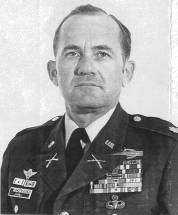
CPT William J. Richardson, Jr.
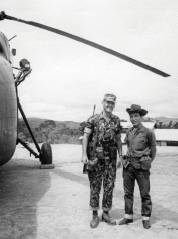
CPT Richardson and famous VNAF H-34 pilot "Cowboy" at Khe Sanh |
Between 24 June and 1 July 1964, five teams, laden with combat equipment,
and wearing smoke jumper gear, parachuted into the jungle of Laos along
Route 9 east of Tchepone. Each team was composed of eight Vietnamese
Special Forces, and each team would operate as a separate entity.
|
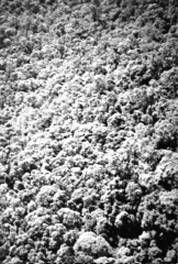
The Drop Zone for Day Training Jump. All those trees
look cushiony, but appearances can be deceiving. They were 90-100 feet
tall. One VN was killed rappeling down from the trees.
|
Two teams were inserted north of Highway 9 astride Route 92; and three
south in the direction of Muong Nong. This area was selected primarily
because of the jungle canopy, which had to be horizontal to make a
good tree jump, and insure hang up in the trees for maximum
survivability. However, the insertion was less than good. One man was
killed repelling from the jungle canopy, and several others were
injured.
Without American leadership and control, Leaping Lena had been doomed to
failure. Despite specific warnings against going into villages, most of
the agents went into the villages in search of food, and were captured or
killed. Only five survivors were able to evade capture, and exfiltrate the
area.
The five who did get out reported encountering company size elements
of VC, and every bridge on
Route 9 guarded by soldiers, which
appeared to be Pathet Lao. Each team had a specific mission, and was to
collect information on enemy activity, to include movement of trucks,
artillery, and heavy equipment. They were to look for any signs
of troop movements of intact units such as companies or battalions.
|
Although Leaping Lena was classified a failure, The intelligence developed
or generated from the five team members who returned, was much more than MACV had prior to that time. It was determined the area was alive with
enemy ground forces, and many were equipped with NVA uniforms. Every
culvert on every road, and every bridge, had a minimum of two enemy
personnel guarding it. Additional roads, not detectable by air, were
discovered, and the movement of convoys noted. The teams found these
through eyeball contact. Units as large as battalion-size were observed,
including one that was in the act of crossing into Vietnam west of Khe
Sanh. This sighting was confirmed by a helicopter crew sent out to
rendezvous with one of the teams.
|
Team members also reported approximately 30 sampans being used
simultaneously to cross company size units. One of the team leaders, after
he was recovered, said, "I attempted to move through the area in the
vicinity of where the battalion was spotted two days prior, and In trying
to follow some of the side roads, I continually had to take evasive action
around guards posted at every bridge and every culvert." This same
information was repeated by several different members of other teams.
There was high density enemy activity throughout the area astride Highway
9 and west of the international boundary.
On 12 June 1964, SF Detachments B1/110 and A1/111 proceeded from 1st
Special Forces Group-Okinawa to Vietnam for a 180 day Temporary duty
assignment. MAJ Frederick Patton and MSG Robert Mattox had arrived a few
days earlier as an advance party. These detachments were assigned to
Project Delta, and their first order of business was to participate in
a search and recovery operation for the survivors of the Leaping Lena
operation. |
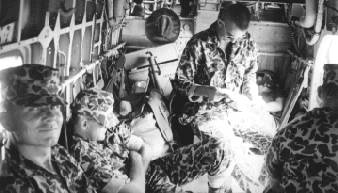
MSG Larry Schell, Unk, and SGM Art Senkewich aboard
Leaping Lena search chopper.
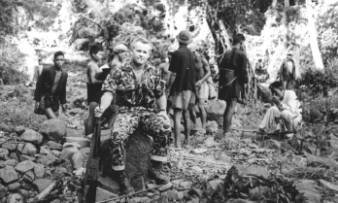
SGM Paul Payne with locals being paid to walk the
border in search for Leaping Lena personnel. |
|
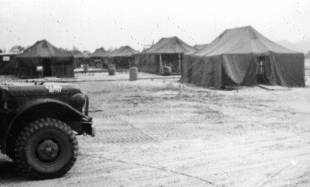
Project Delta's Tent City |
Project Deltas Tent City had already been built when the TDY teams
arrived, and this is where they stayed. All the B Detachment and half the
A detachment lived in the Tent City. The other half of the A-Team went to
Dong Ba Thin, where three Ranger companies were stationed. Half the Nung
Ranger company pulled security around the Project Delta camp. The other
half moved to Nha Trang and joined the training cycle underway with VN
Special Forces. |
|
SF gave the LLDB classes in patrolling, and conducted daylight
tree-landing exercises in the jungle. 1LT Don Snider's "initial
impressions of these Vietnamese, who would be Special Forces, was not
favorable. On 19 June, after five days, 14 of the 18 solders quit. They
were subsequently shipped to Dong Ba Thin by their LLDB superiors. That
effectively ended that cycle, but teams trained earlier were already in
the pipeline for insertion by the LLDB.
"While waiting for new trainees", Snider said, "We prepared new POI for
both one-week, and two-week cycles. Essentially, the subjects were weapons
qualification; basic airborne techniques (drop zone close to Nha Trang and
relatively secure); advanced airborne insertion techniques using four to
eight man recon teams, and making low altitude jumps with no
reserves; use of smoke jumper suit; repelling |
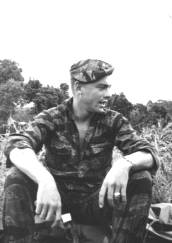
Lt. Don Snider |
from double jungle canopy with
Australian tie-offs; disposing of equipment,
and assembly; reconnaissance techniques; trail watching/reporting
activities; and egress to border SF camp for eventual extraction.
|
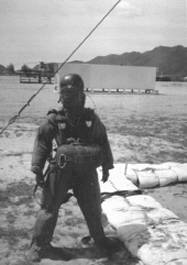
Smoke Jump Suit |
The training exercise consisted of one local jump at Nha Trang, then a
week in the Highlands practicing a night team insertion (low level
jump), and a three to five day patrol in the border area. One or two
Americans from our half team participated in these exercise. After the
field training, in which teams sometimes made enemy contact, we would
turn the teams over to the LLDB for insertion across the fence into
laos, usually in the tri boarder area."
LT Don Snider continued: "The next cycle started on 29 June. On 2
July, we conducted a night jump in the local Nha Trang area, followed
by more training in the compound. Then on 17 July, we made our first
tree jump near Bon Sar Pa, and spent three day running DZ for the LLDB
teams."
During such Field Training Exercises (FTX) away from Nha Trang, it was
not uncommon for 25% of the LLDB
soldiers to simply |
|
disappear into the jungle with the equipment we had given them. Desertion rates were high, and given
the unreliable air support from the Vietnamese Air Force, airborne operations were
always problematic.
We returned to Nha Trang, for the final stage of training, on the 20th and
21st of July. But an altercation in the compound caused the SF Team to
'shake-down' the camp. Weapons were then issued only to those LLDB
departing on exercises." |
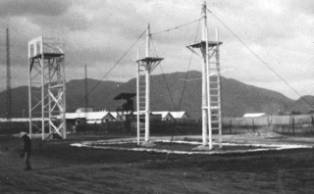
Jump Training Towers |
SSG Stanley Dahl recalls the LLDB as being really sorry. "On training
missions they didn't want to pull their load. On day training jumps, they
didn't want to carry their equipment out of the jungle. Sometime in late
July or early August, we started doing night jumps in gear. One night the LLDB
refused to jump and took off their gear. One of them pointed a .45
automatic at the jumpmaster. It was hard to hold your temper."
|
"I participated in two night combat jumps into the jungle with
tree-landing suits and combat gear. Jim Coates, Charles Battistoni, myself
and six LLDB ran recon patrols, moving only at night. The distance from
point A to B to C was so great we couldn't accomplish our missions, and
had to evade VC tracking patrols which following us. On both patrols we
had to call for evacuation because of the LLDB's lack of security."
SSG Dahl also remembers the mutiny. "Sometime in August 1964 at the
Project Delta camp, we had a mutiny. The LLDB were locked in Isolation
preparing for a mission, but decided they wanted to leave the compound and to go to Nha Trang. |
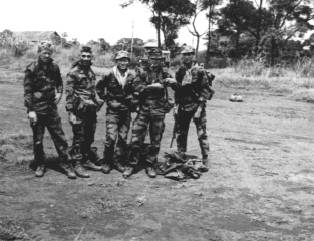
July 1964, Coming off Patrol L to R: SGT James Coates,
SFC Stanley Dahl, unk LLDB, SP4 Charles Battistoni, unk LLDB |
We refused to let them out, and they pulled their weapons on us. We
grabbed our weapons, and got behind sandbags. The LLDB did the same.
The Nung guards, outside the compound, pointed their weapons at the LLDB,
and we had a mexican stand-off. The gate guard called for reinforcements
which arrived about an hour later, and everyone stood down. One LLDB
captain, waving a Thompson sub-machine gun, was disarmed, and arrested by
the SF Team. The following day, an American SF officer with the LLDB
commander, COL Lam Son, came to the camp, and escorted the LLDB out of the
compound. One of the LLDB involved in the mutiny, walked out the gate, and
slapped SFC Luttrell in the face as he left. Luttrell bit his tongue, but
didnt shoot him.
During this period, MAJ Mitchell and MAJ Patton, CO and XO of B-110, had
been investigating the misappropriation of SF assets by this same
commander, COL Lam Son (a nom de guerre for Pham Dinh Thu). It was also
reported that he was under siege by the widows of the men lost in Leaping
Lena, and was later fired because of that failure."
Snider again: "We resumed training in the Highlands on 23 July. MSG Paul
Johnson, one other American, and I accompanied a six man LLDB team on a
patrol to the Cambodian border. As with most such insertions, we were
followed/tracked by VC for most of three days. We were eventually
compromised, and withdrew to the USASF camp west of Buon Sar Pas on 26
July. When we returned to Nha Trang on the 27th, we learned a decision had
been made to train no more LLDB. After that, elements of an ARVN
airborne-ranger company started to arrive in the compound for the next
cycle."
Snider learned on 5 August, that the original members of A/111 would leave
Delta, perhaps to be reunited at Dong Ba Tien. But on 9 August, he was
told his half-team would be broken up and used as individual replacements.
He got orders for IV Corp, eventually joining the A Team in Don Phuc as
XO. Lt Snider completed the remainder of his tour with the CIDG forces
there.
After the mutiny and the investigation, the TDY personnel were scattered
among other SF detachments and MAJ Mitchell was sent back to Okinawa. CPT
Richardson re-assumed charge of Project DELTA.
During the Montagnard Revolt of 1964, DELTA personnel participated in an
ad hoc contingent of volunteers, called Operation SNATCH. They were sent
out to Ban Me Thuot on September 26th to provide the muscle for a show of
force at Buon Sa Par the following day. The troop carrying helicopters
landed about five hundred meters from the camp and negotiators, led by BG
William E DePuy (MACV J-3), arranged the release of the LLDB hostages. The
Task Force then returned to Nha Trang. The Rangers at Dong Ba Thin had
been alerted for this operation, but were not deployed, possibly because
BG DePuy deemed it inadvisable to use anything but U.S. personnel.
Other Reported Operations in 1964, included a POW rescue effort west of
Tay Ninh, near the Black Virgin Mountain (Nui Ba Den). However, no allied
POW's were found.
On 9 December 1964, Delta conducted an operation on the Ninh Hoa
peninsula. This otherwise successful operation was marred by the unwieldy
process required to commit the ARVN Rangers. And caused COL Spears, in
January of 1965, to initiate a request to the VNSFHC which resulted in
field commanders receiving authority to commit the 91st ARVN Ranger
Battalion.
Ninh Hoa:
The operation started on 9 December 1964, on the peninsula
extending east and south from Ninh Hoa, a village north of Nha Trang.
Three teams were committed, but because of rain and fog, insertion did not
occur until 0630. Two of the teams were detected in insertion but the
third was successful and brought back a prisoner and much information.
Team #1 made contact with an estimated enemy company at 1558 on 10
December. Heavy fire drove off the exfiltration helicopter, and two men
became separated from the team. All personnel managed to out maneuvered
the VC while gathering information on the enemys disposition and
activity. The missing men re-joined the team after the brief contact, and
exfiltration were completed. The LZ was on the side of the mountain with
jagged rocks and steep terrain, and the helicopter had to hover on one
wheel while the crew members pulled in the team; The crew chief,
meanwhile, dispatched one VC sniper.
Team #2, had descended into the valley, and made its way to an exfiltration point. As the helicopter prepared to land, a VC ambush was
sprung, and the aircraft were driven off. The team took cover behind a
dike, leaving three of its members pinned down on the LZ; Assuming the
three men on the LZ were dead the team withdrew. A returning chopper
forced the VC to pause long enough to allow the three men to crawl to
cover.
This action occurred on 11 December, but the team could not be extracted
until the 14th. While darkness and torrential rain on the 11th covered all
noise of movement, the three separated team members crawled until nearly
daylight, and found they had penetrated the outer perimeter of an enemy
base camp. Throughout the day, the three hid in the undergrowth. At one
point, a VC search party stopped for a food break, and remained within
arms reach of the team for thirty minutes. That night, the three crawled
out of the enemy camp, and made radio contact with a helicopter. They were
directed to the only available LZ - 50 meters on the far side of a village
held by 2 reinforced VC platoons. And at 0500, all three, with the 2
Americans supporting the wounded VNSF, stood up and walked right through
the village; They counted on darkness and rain to fool the VC into
mistaking them for friendly forces, and the ruse succeeded; they even
waved to a guard who was smoking a cigarette!
Gaining the far edge of the village, they hid in a clump of bushes until
1002 hours, 14 December, when a break in the weather allowed a helicopter
to land. The enemy opened fire, but the extraction was successfully
completed.
The teams had called in airstrikes resulting in 16 VC killed, 17 wounded,
and 4 captured; Follow-up air strikes killed 39 additional VC, 2 complete
squads were captured, and 22 tons of rice were destroyed. The rest of the
enemy was forced back into the hills and a village of 58 families
liberated from VC domination. Friendly casualties were only 1 VNSF
wounded. The operation was a success; 30 personnel had disrupted an entire
VC network and routed a reinforced company.
Also In December of 1964, a 5th SFG(A) PCS detachment under MAJ Art
Strange took over PROJECT DELTA. Another PCS A Detachment, under CPT
Thomas Pusser, later killed at Plei Me, and a TDY team from Okinawa, under
CPT Paul Smith, shared the Ranger and Recon responsibilities.
Up to this point, Special Forces Teams, TDY from the 1st and 7th SFG, had
formed Project Delta, and managed Leaping Lena. This first year was
essentially reconnaissance and ranger training, with actual combat
practical exercises.
To be continued in Part II
Additional chapters to Deltas history will be added later. But for more
immediate information on Project Delta and Special Forces, visit
Steve
Shermans website and support his research effort by purchasing one of
his products.
HOME

|