|
Hugh Shelton
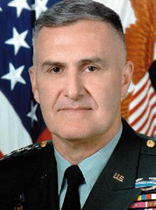
Commissioned
as a second lieutenant in the Infantry through the Reserve Officer
Training Corps, he spent the next 37 years in a variety of command and
staff positions in the continental United States, Hawaii, and Vietnam,
serving two combat tours in Vietnam - the first with the 5th Special
Forces Group, the second with the 173rd Airborne Brigade. He also
commanded the Third Battalion, 60th Infantry in the Ninth Infantry
Division at Fort Lewis, Washington, served as the Ninth Infantry
Division's chief of staff for operations, commanded the First Brigade of
the 82nd Airborne Division at Fort Bragg, North Carolina, and was the
Chief of Staff of the Tenth Mountain Division at Fort Drum, New York.
During his tour with the 5th Special Forces Group General Shelton then lst.
Lt. Shelton lobbied to become part of Project Delta. He was successful in
being assigned to the Project was declined his request to be a Recon team
leader because he was to damn tall. Fortunately for him and the Recon
Section the Lt in charge rotated out of Delta and Hugh was given command.
Sheltons trademark leadership style was evident even as a young Lt. His
approach to leading this group of seasoned NCOs, squirrelly young NCOs and
clueless Lts. was to listen carefully to what each person had to say,
formulate mission plans together and support his troops on the ground. The
also lead from the front. When the Project became short of Recon teams
during its first 1967 venture into the Ashau Valley, Hugh formed a team
including an NCO big enough to carry him should he be hit and pulled his
rotation.
For many of the Lts. who served under him during his time at Project Delta
he set a lifelong standard for the behavior of leaders. He has never
forgotten his time in Delta and has been generous in his support of its
former members.
Selected for promotion for brigadier general in 1988, General Shelton
served two years in the Operations Directorate of the Joint Staff. In
1989, he began a two-year assignment as the Assistant Division Commander
for Operations of the 101st Airborne Division (Air Assault) at Fort
Campbell, Kentucky, during which he participated in the liberation of
Kuwait during Operation DESERT SHIELD/STORM. After the Gulf War, General
Shelton was promoted to major general and assumed command of the 82nd
Airborne Division, Fort Bragg, NC. In 1993, he was promoted to lieutenant
general and assumed command of the XVIII Airborne Corps. In 1994, during
his tenure as Corps commander, General Shelton led the United States Joint
Task Force that restored democracy in Haiti. In March 1996, he was
promoted to general and became Commander in Chief of the U.S. Special
Operations Command.
General Shelton became the 14th Chairman of the Joint Chiefs of Staff on
October 1, 1997, and served two 2-year terms. Throughout his tenure as
Chairman, U.S. forces were in heavy demand and participated in numerous
joint operations around the globe.
During his tenure, he worked tirelessly on behalf of service members,
their families, and military retirees by championing a number of landmark
quality of life initiatives, including: the largest pay raise in 18 years,
pay table and bonus reform, and critical improvements in both retirement
and healthcare programs. He made great strides in improving the readiness
and retention of the current force while simultaneously crafting Joint
Vision 2020 - the roadmap for the Future Joint Force. General Shelton also
established Joint Forces Command to consolidate joint experimentation
efforts and guide the transformation of the U.S. armed forces for the 21st
Century.
General Shelton holds a Master's Degree from Auburn University, and has
attended Harvard University, the Air Command and Staff College, and the
National War College. He has been decorated for distinguished service by
numerous military and civilian organizations in the United States and
overseas.
BACK
HISTORY

|