|
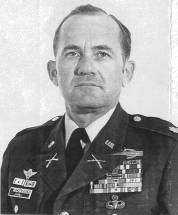
(NOTE: The following article by Kevin Maurer was originally published in the Fayetteville Observer - Sunday, Jan. 28, 2007) Former COSCOM commander Bill Richardson, who was a prisoner of war in North Korea for 34 months, continues to serve soldiers and other former POWs.
Only once did retired Col. Bill Richardson think he
wasn't going to make
it out of a North Korean prisoner of war camp in 1950.
A prisoner at Camp 5 "outside Pyoktong near the Manchurian border"
Richardson, who was already wounded, was hurt working outside the camp.
Slowly, his legs started to grow stiff. His Achilles tendons turned blue
and swelled thicker than his thumb.
Soon, he couldn't walk.
The guards dragged him to the hospital "called the morgue by the
Americans" and threw him on top of dying prisoners who cursed and
kicked at him in the small room.
Sick from dysentery, he dragged his broken body outside to a dirt trough
the soldiers used for a toilet. But the earth crumbled beneath him and he
fell in.
He yelled out and clawed at the walls of the trench as his paralyzed legs,
like an anchor, pulled him toward the bottom. The filth was up to his chin
when two fellow prisoners pulled him out.
The commotion attracted the guards, who started beating Richardson. He
lost control of his bowels and thought of giving up.
Giving up meant death.
"That was the first and last time I ever thought of dying," he said.
Richardson eventually fashioned a pair of tree limbs into crutches and
walked out of the morgue and two years later out of the prison camp.
He made a pact with himself afterward to never look back.
"There were guys that talked about nothing else for the rest of their
lives," Richardson said. "never dwelled on that."
The key was controlling his mind, a skill he says he turned into a drive
to succeed.
A black and white picture from the Philadelphia Public Ledger shows a
young Richardson returning home from Korea in 1953.
He is wedged between his mother and father. His mother's face is buried
in his neck. His father, on the verge of tears, is staring at the camera.
Richardson has a smirk on his face and his khaki uniform hat is cocked to
one side of his head.
The homecoming was the start of Richardson's courtship of Claire, his
wife of 53 years.
Richardson's parents were divorced, and his father brought his new wife
and family to the airport.
Richardson had met his father's new wife "including her 16-year-old
daughter, Claire" one Sunday just before he deployed to Korea.
"I thought he was one cocky SOB," Claire Richardson said. "Plus, I
had a boyfriend."
Richardson, who had been stationed in Europe before getting orders for
Korea, didn't think much of her at the time, either.
"I had a girlfriend in Austria," he said.
Still, he and Claire posed for a picture that Sunday before he deployed.
He never saw the whole photo but he did see half of it a few years
later in Korea.
He had just been transferred between prison camps and was sitting with
other soldiers from Philadelphia when one of them pulled out a photo.
"This is my girlfriend," the soldier said as he passed it around.
When he arrived at Special Forces headquarters, the deputy commander
called him into his office. "Yarborough doesn't want you," the commander told him.
Lt. Gen. William Yarborough "architect of the Special Forces was
building the unit from scratch and wanted the Army's best.
Since Richardson hadn't completed college, Yarborough apparently didn't
think Richardson was smart enough. But the deputy commander, a friend of
Richardson's, vouched for him.
Richardson went on to serve with both the 5th and 7th Special Forces
Groups.
With war raging in Southeast Asia, he found himself in Laos and finally in
Vietnam.
His first command in Vietnam was Project Delta. He was the unit's first
and third commander.
"I know I was selected because of my past combat experience,"
Richardson said.
Formed in 1965, Project Delta used Vietnamese troops and later teamed with
U.S. troops, for reconnaissance missions along the Ho Chi Minh trail.
"He was only a captain, but he was the right man for the job," said
Paul Payne, Richardson's sergeant major when he commanded Project Delta.
"He knew what the mission was and he knew how to get it
done."
Richardson's first stint with the unit was successful. He was the first
to infiltrate and recover teams from North Vietnam.
Richardson was working at Special Forces headquarters when he took over
Project Delta the second time.
"Meet me at the airfield," he was ordered by his commander.
Richardson was going to Saigon to brief the embassy about Project Delta.
The Army was giving him command again.
Richardson could hand-pick the unit. Payne remembers how Richardson was a
good judge of character who cared deeply for his soldiers.
"He had that natural intelligence. That common sense," Payne said. "He
was able to overcome stuff a common individual would not be able to
comprehend."
Project Delta was one of the most highly decorated special operations
units in Vietnam.
The unit captured vast amounts of equipment and supplies and identified
major enemy installations and supply routes.
Richardson retired in 1985, but he never stopped serving.
He is the commander of the organization for former POWs in Fayetteville
and the national director for the American Ex-Prisoners of War. He also
sits on the board of directors for the Former POW foundation, a charity
that raises money for military-related organizations such as Fisher House.
The house provides a place for military families to stay on Fort Bragg
when there is a crisis.
This summer, Richardson also became the national president of the 1st
Cavalry Division Association.
But it is being with soldiers that Richardson likes the most.
In November, he and three other former POWs met with students in the Army's
Survival, Evasion, Resistance and Escape "SERE" course.
Standing in front of the stage, Richardson told his story with humor and
grace. He told them about death marches and dysentery. Starvation, lice
and beatings. When he got to the part about his decision to live or die,
Richardson had every student's attention. "You've got to control your mind. It can tell you things you
don't
want to do," Richardson told the students.
A simple lesson and one Richardson still follows. "The sun isn't setting for me
yet," he said. "Life is made to
live."
|