|
The Carpenter Brothers 1969-1970
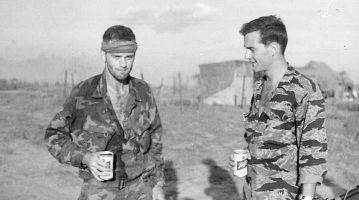
Many
brothers served concurrently in Viet Nam, and several brothers served
together in the 5th Special Forces Group. The Carpenter brothers served
together in Project Delta.
Derick and Steve Carpenter were the first and second of seven children
raised in upstate rural New York. Their father, an elementary school
principal, was a veteran of the North Africa campaign in WWII, and all
three of his brothers were veterans of action in Europe and the South
Pacific. Their mother, a registered nurse, was a member of the Nurses
Corps stationed in New York City during that war. Even so, it surprised
many when the two brothers, both high school athletes and honor students,
abandoned their college efforts in 1967 and enlisted in the army a month
apart. The escalating activity in Viet Nam had caused increasing unrest on
college campuses around the nation and the truth of the conflict was
indiscernible. That, coupled with the fact that several friends,
neighbors, and high school classmates had been killed or wounded, prompted
the two to go and see for themselves what the real story was. Both figured
that the easiest way to get to the middle of it was to enlist in the
outfits historically on the front lines. They both enlisted with a
guarantee that they would go to the airborne infantry. There just happened
to be a couple of slots open.
Derick was selected for Military Police school at Fort Gordon, Georgia,
and then went to jump school at Fort Benning. He was assigned to the 82nd
Airborne Division at Fort Bragg and went about being a military policeman.
He submitted request after request for assignment to Viet Nam and got
nowhere until December of 1968, when the father of an old girl friend, a
three star general, intervened on his behalf and he was assigned to an MP
Brigade in Bien Hoa. After a few months chasing VC through plantations
during Tet of 69, he volunteered for the PBR unit at Vung Ro Bay.
In the mean time, Steve went through the advanced infantry training at
Camp Crockett in Fort Gordon. From there he went on to jump school and was
recruited for Special Forces Training at Fort Bragg. After completing the
Phase I training and the first 12 weeks of medic training, he became
stalled awaiting new classes for the 52 week school at Fort Sam Houston. A
very rare opportunity to attend the SF Operations and Intelligence course
arose from a critical shortage of that MOS in Viet Nam. The O&I course was
reserved for the very senior NCOs in SF. Along with the MOS came a
guaranteed assignment to the 5th SFGA. Immediately upon graduation, Steve
received orders to 5th Group and reported in April 1969. During the Combat
Orientation Course in Nha Trang, all the young O&I specialists were made
aware of the special operations detachments and encouraged to apply their
new found wisdom there. Steve volunteered for Project Delta. After
completing the MACV Recondo school, he reported to the recon section.
Upon his return from his first FOB at An Hoa, Steve was surprised by a
visit from Derick at the Projects Nha Trang home base. Derick spent a
couple of days engaged in the antics of the boys on stand down and
determined that he would like to stay. After plying himself with some fuel
from the Delta Hilton, he approached Doc Simpson with the notion that he,
too, would like to run recon. Doc interviewed him and agreed that if he
could pass the MACV Recondo school course he could join Delta. Over the
course of the next two months the reassignment was made.
For the remainder of the year, the two brothers were assigned to various
recon teams to be mentored and field tested. Docs rules were simple; the
brothers were not allowed to run together on the same team, be on the
ground at the same time, or accompany the Nungs together on immediate
reaction missions. For the most part the missions were routine for the
Project, which is to say that they were exciting, and at times,
frightening. Each was involved in pursuit by enemy forces, hot LZs,
discovery of enemy routes and positions and engagements with enemy troops.
Neither was involved in any epic engagement that turned the tide of the
war. They continued to volunteer for missions and do their jobs.
As the effort to turn all military activities over to the VN gained
momentum, more requests for extended duty were denied. Steve was sent home
in April, 1970, after one year in-country, and was assigned as an
instructor at the Special Forces Training Group at Fort Bragg until he
left the service to get married and return to Cornell University at the
end of August. He earned his BS in 1974. Derick stayed until July of 1970,
near the shut down date of Project Delta. He was discharged and resumed
his college career at Albany State. He earned his BS and MS in psychology.
Steve went on and had a successful career in the highly emotionally
charged field of nuclear and hazardous waste and eventually held positions
as an officer of several public and private companies. He is now retired
on full disability and lives in Idaho with his wife of 35 years, Paula. They have one son, Steve,
who graduated from MSU in Bozeman, MT in December 2004. Derick
spent a few years evaluating mental health programs for the State of New
York, first as an employee, and then as a private consultant. His behavior
became erratic and he developed seizures. He turned to the VA for help. In
return, he received a letter that threatened a lawsuit if he persisted in
his story of serving in a classified special operations unit in RVN. He
had become totally unable to function in society and was finally declared
disabled by the VA for PTSD. He retreated to his frame construction cabin
in the Adirondacks and lived a primitive life style with only a generator
for electricity, and a spring for fresh water. He heated the cabin with
wood. He subsisted on rehydrated noodles similar to the soup mix that the
recon section used to make while at FOBs. He had a three legged dog and a
couple of cats for company and began to drink heavily instead of taking
his medication. In the summer of 1992, Steve, then living in Wyoming,
returned to the Adirondacks with his family to visit Derick and their
mother, who lives nearby. He discovered Derick living in filth and far
beyond coherent. He loaded him into the rental car and headed the 200
miles to the VA center in Albany. Steve left Derick in the care of a
seasoned psychiatrist that Derick trusted and told him to plan on keeping
him there for the rest of his life. He just couldnt care for himself any
more. This act of intervention was perhaps the hardest thing Steve ever
did in his life.
As it turned out, the VA put a full court press on Dericks condition and
finally, after 22 years, correctly diagnosed him with cerebral malaria.
While certainly not great news, it explained the symptoms and behavior and
provided a clear path for treatment. By mid 1993, Derick had checked
himself out of the VA hospital, returned to his cabin and began leading a
much more normal life. Late in the fall he voluntarily returned to the VA
for a tune up. On December 16th, 1993, Derick, upon hearing that his
mother had had some major surgery, checked himself out of the hospital and
returned to his cabin to be near her. That night he stoked his fire, took
his medicine, and went to sleep. Early in the morning of December 17th,
his chimney ignited, followed by the rest of the cabin. He and his three
legged dog never woke up. The only items that survived the fire were
Dericks Delta ring and his engraved Zippo lighter, which says, They may
not like us, but theyll never forget us. Detachment B-52 Project Delta.
Steve
Carpenter's Photo Collection
BACK
HISTORY

|