|
Charlie A. Beckwith
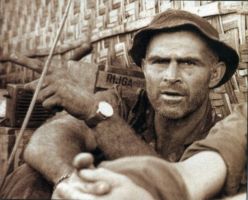
NOTE: Until a biography can be constructed for my old friend, Chargin
Cholly, this article from the Atlanta Constitution, dated June 14, 1994,
will remain here. NOTES: by Jim Tolbert
CHARLES BECKWITH DIES; LED MISSION FOR IRAN HOSTAGES
By Tom Bennett
Charles Beckwith, a retired Army colonel and Atlanta native who led the
abortive 1980 mission to free American hostages in Iran, died Monday at
his home in Austin, Texas. He was 65.
His wife, Katherine, called police after finding Beckwith dead in his
bedroom. Police said he apparently died of natural causes.
Beckwith led Delta Force, a 130-man anti-terrorist unit that flew to Iran
on April 24-25, 1980, and tried but failed to rescue 52 Americans held
hostage.
Three of eight helicopters in the mission failed; six was a minimum
needed, and Beckwith scrubbed the mission. During the retreat, tragedy
struck when a helicopter moving to re-fuel from a C-130 cargo plane struck
it and both burst into flames. Eight servicemen died.
Iran held the Americans for 444 days before the Ayatollah Khomeini ordered
them released in January 1981 as President Carter left office, and while
Carter's successor, Ronald Reagan, stood on the inaugural stand.
"Chargin' Charlie," as Beckwith was known, was a 6-foot-3 Green Beret
officer and decorated hero of the Vietnam War.
At Atlanta's Brown High, Beckwith was an all-state football player and
went on to become a three-year starter at guard for the University of
Georgia.
A student ROTC leader, he received an Army commission in 1952. He became a
maverick officer who bucked the establishment at every turn. After a
year's training with a British anti-terrorist unit, Beckwith campaigned
for 14 years in the Army hierarchy to create a U.S.A. anti-terrorist unit.
The result was "Delta Force."
The Iran mission effectively ended Beckwith's military career. Back in the
United States, he was ordered to hold a press conference, at which he said
he had canceled the mission because "I'm not going to be a party to a
halfway loading of a bunch of aircraft and going up and murdering a bunch
of fine soldiers. I'm not that kind of man." He retired from the Army in
1981 and formed an Austin consulting firm, Security Assistance Services.
He wrote a 1983 book, "Delta Force," with Donald Knox in which Beckwith
blamed the helicopters and their Marine pilots for the failure of the
rescue mission.
Charles Alvin Beckwith was born Jan. 22, 1929, in southwest Atlanta, one
of three children of an independent oil dealer.
He grew up near Atlanta's Fort McPherson. He went there on Sundays to
watch polo matches and dreamed of having an Army career, his mother
recalled.
At Brown high, Beckwith was a football teammate of Pepper Rodgers, later a
college and pro coach, and at Georgia, Beckwith teamed with Marion
Campbell and Zeke Bratkowski, later NFL players and coaches.
Three years into his Army career, in 1955, Beckwith joined the 82nd
Airborne Division. (NOTE: Charlie started out in the 82d as commander of
Support Company, 504th Airborne Infantry Regiment.) He was pissing people
off even back then. I remember him telling a member of the Regimental
Staff, "I'm a company commander, not a God Dam football player". In 1958,
he moved to the Special Forces, or Green Berets, "because they needed
officers," he recalled. In 1960, Beckwith was an American adviser in
Vietnam and Laos, and 1962-63 he trained with the British 22nd Special Air
Services Regiment.
Back in Vietnam in 1965, (NOTE: This was Charlie's assignment as commander
of Special Forces Detachment B-52, Project Delta.) Beckwith led a 250-man
force that rescued a Green Beret garrison at Plei Me. He and the other
rescuers stayed and fought another eight days until the enemy departed.
Beckwith later learned he had faced regular North Vietnamese troops and
told the press: "Give me a battalion of them and I'll take over the whole
darned country." The remark was taken as a slap at the Americans' South
Vietnamese allies, and after that Beckwith avoided the press.
Click here to read related story by Joe Galloway
on the Seige at Plei Mei
On a 1966 mission while flying in a helicopter, Beckwith was hit by a
.50-caliber bullet. (NOTE: This was the operation that later became a best
selling book, and the movie, "We were soldiers once, and Young".)
According to the Chicago Tribune, Beckwith at various times criticized the
Special Forces command and air cavalrymen in charge of ferrying his Green
Beret troops into action.
His superiors now heeded his suggestion for a U.S. anti-terrorist unit,
and in 1974 Beckwith was told to implement his plan. "Delta Force"
officially was born at a meeting of high-ranking officers at Fort Benning
in 1976. Beckwith won promotion to colonel. He located his unit in an
unlikely place - the stockade at Fort Bragg, N.C. Its high fence afforded
the security they wanted for secret training. The post's prisoners were
transferred to a jail in a nearby town.
(NOTE: This writer omits Charlie's return to Vietnam after his recovery
from the GSW, and his assignment to a conventional unit. He also overlooks
Charlie's tenure as Commandant of Special Forces Schools at Fort Bragg.)
Beckwith's unit scaled a significant hurdle in 1977, receiving the
endorsement of Gen. Frederick "Fritz" Kroesen, then commander of FORSCOM
at Fort McPherson and in charge of all ground troops in the continental
United States. An aide to Kroesen had campaigned in the Army establishment
to transfer Delta Force's anti-terrorism activities to other units. In
June 1977, Beckwith won a bureaucratic struggle when Delta Force was
placed under the direct operational control of the Department of the Army,
bypassing other commands.
U.S.-Iranian relations worsened after Carter permitted the country's
ailing shah to enter the United States. In October 1979, Delta Force went
through a "validation exercise," a simulated anti-terrorist action watched
by experts from NATO countries. Beckwith was returning home when he
received a call that the embassy in Tehran had been seized and orders that
he go on alert.
He stepped up training. Delta Force built a mockup of the embassy and
practiced assaults. They rehearsed breaking down doors and storming into
darkened rooms.
He took part in a White House briefing on the rescue mission, and was
surprised when Carter gave a go-ahead.
"I didn't think he had the guts to do it," Beckwith wrote later. He had
not voted for Carter and had been angered when Carter had given amnesty to
U.S. draft dodgers in Canada.
After the mission, Beckwith returned to the White House. Carter thanked
him for "going public" by holding a press conference. Beckwith asked if he
could tell the president something.
"Of course, colonel," Carter replied.
"Mr. President, me and my boys think that you are tough as a woodpecker's
lips."
Surviving besides his wife are two daughters, Connie and Pegg.
BACK
HISTORY

|