|
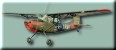
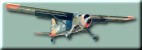
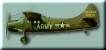
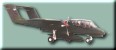
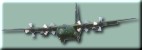
Some of the aircraft that supported
Project Delta. Click on each for more information. |
History of Aviation Support for
Project Delta
"THANK THE ARMY FOR MY TRAINING
AND MY OLD RUCK SACK
BUT WHEN I'M ON THE GROUND
THANK GOD FOR THE FAC"
Unknown Recon Team leader
General:
Special Project Delta, Detachment B-52, 5th Special Forces Group,
successfully accomplished assigned missions with excellent aviation
support provided by many outstanding Army, Navy, Air Force, and Marine
aviation units.
During the life cycle of Project Delta, the U.S. Navy, and Marine Corps, in
many instances, provided critical aviation support, but U.S. Army and Air
Force units provided the bulk of this requirement. This included
transportation to and from the operational areas, team insertions,
extractions, medical evacuations, and close air support. Air Force cargo
ships moved the unit to and from the operational area, and Air Force
Controllers assisted teams, identified targets, and made effective use of
Air Force, Navy and Marine tactical air support. Army aviation units
provided aircraft for Airborne Radio Relay, and Army and Marine Units
provided Helicopter support.
From initial organization of Project Delta, and the first mission,
aviation assets were attached. However, on almost every operation from
1964 to 1970, additional army, and/or marine aviation support was provided
by the units Delta worked for. In many instances, these army and marine
units provided the total aviation requirement, limited only by their
assigned assets.
In 1964, most aviation support was provided by Vietnamese Air Force
elements. Using the L-19 for tactical air control and airborne radio
relay, and the H-34 for command and control, insertions, extractions, and
medical evacuation; Project Delta prosecuted its long-range reconnaissance
mission under the code name Leaping Lena.
LTC Leonard A. Boulas, Operations
Officer, Project Delta, 12/01/64, remembers the following:
|
"The air assets we had in 1964 were from the Vietnamese Air force (VNAF).
At that time the Vietnamese Army did not have an operational air element.
We used H 34 helicopters and two C 47 cargo planes. Radio relay was
initially done using the C 47s but their time over the operation area was
limited. We then used U.S Army Otters from the 5th RRU for this purpose.
The L 19s (not sure if the Air Force 0-1Fs were the same as the L 19, but
they looked like it) were used when the first FACs from the U. S. Air
Force flew missions supporting the Project.
The C 47s were first assigned to transport the Vietnamese 91st
Airborne Ranger Battalion reaction
force,
to re-supply the |
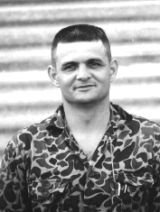
CPT Len Boulas - 1965 |
deployed recon teams, and fly
administrative, logistical, and R & D missions. From time to time we got
U.S. gunship support, and in some cases, used other aviation resources.
Normally when we went on a mission, we had Military Advisory Command
Vietnam (MACV) priority to move (C 130 aircraft) the headquarters staff,
reaction force, and recon teams. Once the mission was over, it was hitch a
ride back to the base camp in Nha Trang as best you could. I remember a
lot of times sitting on the run up strip of a runway with a company of
Rangers, and other personnel, looking for an aircraft which might be going
our way." Leonard A Boulas, LTC, USA, Ret.
On 15 May 1964, the U.S. Mission in Saigon initiated the program, Leaping
Lena, and in June, transferred it to the Military Assistance Command and
Special Forces under Operation SWITCHBACK. In October, it became Special
Project Delta. The 5th Special Forces Group created Detachment B-52 as a
controlling Headquarters in June 1965.
U.S. Air Force:
"The first U.S. Air Force Forward Air Controllers (FAC) used by
Project Delta were TDY from the 19th Tactical Air Support Squadron (TASS),
which arrived in country with 22 0-1F aircraft in July 1963."
The 21st TASS, which would later provide Deltas permanent tactical air
support element, was activated on 8 May 1965, and became operational in
August that year. One of the first actions by this unit was an effort to
open Highway 21 from Deltas home base in Nha Trang to Ban Me Thout.
Within six days, 28 August to 3 September, over one hundred air strikes
involving every type of strike aircraft belonging to Air Force, Navy, and
Marine Corps, were directed by the three Nha Trang FAC's.
21st TASS records indicate that on 1 January 1966, four Forward Air
Controllers were attached to Project Delta. However, in January 1966, the
only FACs working Delta were Jim Ahmann and Ken Kerr, and they were TDY
from the 19th TASS. Initially, only one FAC, one
Radio Operator, and one 01-E Aircraft had been attached. However, as
missions multiplied, Deltas need tripled, and additional Air Control
assets were brought in.
John F
Flanagan, BG, USAF Ret Remembers:
"Capt. Ken Kerr and Capt Jim Ahmann were the initial FACs permanently
assigned to Delta. I replaced Ken in April of 1966 on the ChuLai
Operation, initially TDY and then permanently assigned. I was a 1st LT.
Lt. Carlton Skinner Simpson replaced Jim Ahmann. around June of 1966. When
Projects Omega and Sigma were formed, Skinner was assigned to II Corps
(Omega or Sigma?) and Delta had only one FAC. We didn't use any TDY FACs
because the learning curve was too steep for them. Finally, in Nov of 1966
another FAC was PCS'd to Delta when we were in Khe Sanh. That was Capt.
Charlie Swope. He was shot down on his 5th mission with Delta, Sgt.
Glidden in the back seat was also killed. Tommy Carpenter led the recovery
team.
At that time, all FACS for Delta had to have at least 6 month experience
in country, volunteer for Delta, and pass the approval of Recon after an
initial operation.. (We fired one FAC because the Recon teams stated "he's
going to get himself or us killed".) Capt. Al Groth replaced Capt. Swope
and at this time, Delta was assigned 2 AF Bird Dogs after AF hierarchy
realized it was suicide to fly single ship in I Corps. (All other I Corp
FACs flew two ship missions). I left Delta in early Jan of 1967, after
second Khe Sanh deployment. I would like to think that Delta got the best
FACs from the AF during that era. Jim Ahmann, myself, and Skinner Simpson
were all AF Academy grads, and Charlie Swope was an Annapolis grad who
cross commissioned in the AF.
AF resources were a TACP, Tactical Air Control Party, comprised of two
officers and one or two enlisted radio operators/maintenance (ROMADS) plus
a MARK 108 Communications Jeep that had FM, VHF, UHF, and a very powerful
HF/SSB. Airman Rudy Bishop was with Delta much of this time. He lived in
the Delta compound and would pull shifts with the Delta Commo when things
were slow on the AF net. With the HF, we could reach Saigon from KheSanh,
and the ROMADS on occasion would contact the Philippines.
As for fighter support, Delta had the highest priority for fighter support
since almost all of our missions were of an immediate nature. We approved
our own strikes, no interference from any chain of command. What Delta
wanted, Delta got. Aircraft in flight were frequently diverted from
scheduled targets to support Delta. We used VNAF, Marine, Navy, and Air
Force fighters."
John F. Flanagan, BG, USAF, Ret.
ALO/FAC, Project Delta, April 1966-Jan 1967
Author of "Vietnam Above the Treetops: A Forward Air Controller Reports."
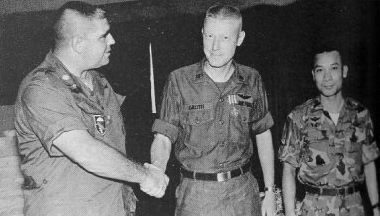
Maj. Charles Allen, Project Delta CO (left) congratulates
Air Force Capt. Allen R. Groth who was awarded the Distinguished Flying
Cross for valorous actions performed in support of Project Delta. At right
is Maj. Pham Duy Tat, Allen's Vietnamese Special Forces counterpart.
Unlike the other Aviation Support Elements, Air Force Controllers, and
support personnel lived with and became a part of Project Delta. The FACs,
and accompanying personnel, who were assigned to Delta, lived and worked
with the unit at their Nha Trang Headquarters and each Forward Operation
Base (FOB).
Nighttime Airborne Radio Relay capability was made available to the
reconnaissance Teams of Project Delta by the Air Force Airborne
Battlefield Command and Control Center (ABCCC), an Air force C-130 on
station over Southern Laos with the call sign, Moonbeam. Airborne Radio
Relay during the day was usually accomplished using the U-6 Beaver, and/or
U-1 Otter organic to Army Aviation Units in the Corps area of operation.
Link:
505th Tactical Control Group - Hq Unit of
21st TASS
Army Helicopter Support:
Helicopters played an important roll in the operations of Project
Delta, and were essential for insertions, extractions, medical evacuation,
and close fire support. Early on, primary helicopter support was provided
by the VNAF using H-34s. Later, it was almost always provided by U.S.
Forces. But no matter who provided primary helicopter support, the units
Delta supported augmented this, as illustrated by the following extract
from an Operational Summary:
Subject: Marine Aviation Support
1st Marine Aircraft Wing, III MAF, VMO-3, Operational Summary, 21-23
May.
21 MAY 1967: Six armed escort missions were flown in support of
Project Delta.
22 MAY 1967: Ten armed escort missions were flown in support of
Project Delta.
23 MAY 1967: Four armed escort missions were flown in support of
Project Delta.
Vietnamese Air Force elements supported Delta from its beginning until the
end of 1965 using H-34s. L-19s, and C-47s. However, as late as 1969, Delta
was still using VN aircraft, when nothing else was available. In many
instances between 1967 and 1969, when Delta assets were all committed,
commanders had to beg for, and take, whatever additional aircraft support
they could find. It was in these cases when VN aviation support was
provided.
As Deltas need outstripped the capability of
the Vietnamese Air Force, additional support was obtained from U.S. Units.
This support by U.S. Aviators, untrained in Delta operations, was less than
satisfactory. Constant changing of equipment, and the requirement to keep
training new personnel, led to Deltas request for its own aviation unit.
The first American Helicopter Unit attached to Project Delta was the 145th
Airlift Platoon (UH-1B Slicks).
LTC Leonard A. Boulas, Operations Officer, Project Delta, 12-1-64,
remembers:
"The reason for going from the Vietnamese Air
assets to U.S. assets was not a call made by the Project. MACV decided
to pull the Vietnamese air assets so Special Operations Group (SOG) could
use them. We were not happy campers in the Project when that happened.
Right after that, U.S. Aviation resources were assigned on an operational
basis, which to say the least, was a major problem. Finally after much
bitching by Project and Group Commander, Air resources were permanently
assigned to the Project.
Early on, the VNAF aviation resources were assigned to us. We paid their
salaries, food and lodging (Villas in Nha Trang). They operated at our
direction and only if the VNAF Air Marshal had a special operational need
were they not available. This was done in coordination with the Project
and normally only effected the availability of the C 47s.
I believe the VNAF air assets came out of the 219th Special Operations
Squadron. The King Bees (H 34 personnel) from this squadron were
recognized at Special Operations Association Reunion (SOAR) XXVII last
year for their support to SOG. Whether or not any of those people were in
the original group that supported Delta in 64-65 I am not sure."
Leonard A Boulas,
LTC, USA, Ret.
Although the 145th provided Helicopter
support to Project Delta in 1965, The first appearance of the 145th Air
Lift Platoon in direct support of Delta operations shows up in the After
Action Report (AAR) for Operation 1-66 (Binh Hoa), 2 Jan 1966, Forward
Operational Base (FOB) Di An.
The 145th Airlift Platoon (UH-1B Slicks) were moved to Nha Trang to
support Headquarters, I Field Forces, Republic of Vietnam on 6 January
1965. Later that year on 25 December, the 145th was reassigned to the 10th
Combat Aviation Battalion, and began training with Project Delta. Thirty
days later, 25 January 1966, the 145th was consolidated with the 6th
Aviation Platoon (UH-1B Gun ships) to form the 2nd Platoon, 171st Aviation
Company (AC).
The 171st AC provided Helicopter support as directed by the 5th Special
Forces Group (Abn), also Headquartered in Nha Trang. The primary mission
of the 2d Platoon became direct support to Project Delta, and its
reconnaissance training activity, which later became the RECONDO School.
The 2/171st were placed under Operational Control (OPCON) of 5th Special
Forces Group.
By July of 1966, the 281st AHC had assumed the aviation assets of the
171st, and was attached to Project Delta for support. Quartered in the 5th
SFGA compound, they continued in that status thru Operation Yellow Ribbon,
December 1969.
During this time frame, 39 operations were conducted by the Project using
the Helicopter assets of more than 23 different U.S. Army and Marine
Aviation units. The 281st AHC, based in Nha Trang, provided primary
aviation support for 24 of these 39 operations. Between Operation Yellow
Ribbon and the de-activation of Project Delta in June 1970, Primary
Helicopter support was provided by the units Delta was OPCON to. See Delta
After Action Reports.
281st AHC Association Website
|